
Dua for Zamzam Water
By Anaya Noor, Senior Travel Writer and Hajj & Umrah Specialist
The best known dua for Zamzam water is the supplication of Ibn Abbas: “Allahumma inni as’aluka ‘ilman nafi’an, wa rizqan wasi’an, wa shifa’an min kulli da’in.” It means: O Allah, I ask You for beneficial knowledge, abundant provision, and healing from every disease. Say Bismillah first, then drink.
Most UK pilgrims first drink Zamzam during Umrah, usually after Tawaf. If you’re planning your trip, our Umrah packages cover the practical side. This page covers the words.
The dua in full
Arabic:
اللَّهُمَّ إِنِّي أَسْأَلُكَ عِلْمًا نَافِعًا، وَرِزْقًا وَاسِعًا، وَشِفَاءً مِنْ كُلِّ دَاءٍ
Transliteration: Allahumma inni as’aluka ‘ilman nafi’an, wa rizqan wasi’an, wa shifa’an min kulli da’in.
Translation: O Allah, I ask You for beneficial knowledge, abundant provision, and healing from every disease.
Here’s something the other guides skip. This wording is reported from Abdullah ibn Abbas, a companion of the Prophet ﷺ, not from the Prophet ﷺ himself. That doesn’t diminish it. It means the practice comes from the generation closest to him, which is why scholars have recommended it for centuries. But knowing its actual chain matters if you want to understand what you’re reciting.
You’ll also find slightly different versions online. Some add “wa ‘amalan mutaqabbalan”, meaning accepted deeds. Others report the wording of Umar ibn al Khattab: “Allahumma inni ashrabuhu li dhama’in yawm al qiyamah”, or O Allah, I drink it for the thirst of the Day of Judgement. None of these contradict each other. They’re separate reports of separate companions, and any of them is fine to use.
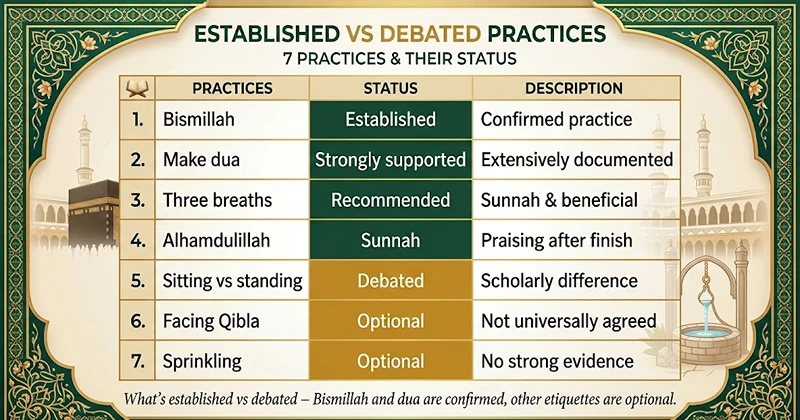
What’s established and what’s debated
This is where most pages present opinion as fact. Here’s the honest breakdown.
| Practice | Status | What to actually do |
|---|---|---|
| Say Bismillah before drinking | Established, applies to all food and drink | Do it |
| Make dua for what you need | Strongly supported by the hadith of intention | Do it, in any language |
| Drink in three breaths | Reported from Ibn Abbas as etiquette | Recommended, not required |
| Say Alhamdulillah after | General sunnah of drinking | Do it |
| Sitting versus standing | Genuine scholarly disagreement | Either is permitted, see below |
| Facing the Qibla | Disputed between scholars | Optional, no obligation |
| Sprinkling on head and chest | Recommended by some scholars | Optional |
Standing or sitting, and why people argue about it
You’ll see pilgrims doing both, and you may see one group looking sideways at the other. Both have evidence behind them.
Al Bukhari and Muslim record that Ibn Abbas gave the Prophet ﷺ Zamzam and he drank it standing. That’s why many people stand. There are also narrations discouraging drinking while standing generally, which is why others sit.
Scholars reconcile these differently. Some hold that sitting is preferable and the Prophet ﷺ stood to show it’s permitted. IslamQA’s position is that drinking while sitting is preferable but standing is allowed, and the Prophet ﷺ did both to show the matter is broad. Some Maliki and Hanbali scholars hold both are equal.
The practical answer: do either. Nobody is doing it wrong, and a crowded Haram often makes the choice for you.
On facing the Qibla, there’s a real split. Some scholars list it among the etiquettes based on a narration from Ibn Abbas. IslamQA takes the view that no hadith from the Prophet ﷺ establishes it. Face it if you can, don’t force it if you can’t.
Does the dua work at home in the UK?
Yes. Nothing in the narrations restricts the supplication to the Haram. The hadith “Zamzam water is for whatever it is drunk for”, recorded in Sunan Ibn Majah at 3062, speaks about intention rather than location.
Which raises the practical question nobody covers. Getting Zamzam home has become considerably stricter.
Saudi civil aviation rules prohibit carrying Zamzam inside checked luggage, and it can’t go in hand luggage either because of the 100ml liquids limit. What you do instead is buy an officially sealed five litre pack at the airport, which is tagged and shipped on a separate conveyor. At Jeddah, packs have sold for around SAR 8.5, roughly £1.80. Umrah pilgrims book theirs through the Nusuk app.
The mistake that costs people is bringing a bottle filled in Makkah and hoping. Unsealed or factory-unpacked bottles get refused, and refilled plastic bottles have burst in cargo holds and ruined other passengers’ luggage. Buy at the airport, one pack per person, and don’t improvise.
At Jeddah Terminal 1, packs are sold at four points. These are outside the North Hall gate, inside Hall A, outside Gate B2, and outside Gate C2. Your pack is tagged and goes on a separate conveyor from your checked luggage. So you do not hand it over at the normal bag drop. Allow extra time before your flight. This is a second queue, in addition to check-in. Checks are stricter at Jeddah than at Madinah.
Frequently asked questions
What dua to say when drinking Zamzam water?
The most widely used is Ibn Abbas’s supplication: Allahumma inni as’aluka ‘ilman nafi’an, wa rizqan wasi’an, wa shifa’an min kulli da’in. O Allah, I ask You for beneficial knowledge, abundant provision, and healing from every disease. You may also make any sincere dua in your own language for whatever you need.
What is the correct way to drink Zamzam water?
Say Bismillah, make your dua, drink in three breaths pausing between sips, drink your fill, then say Alhamdulillah. Sitting is generally considered preferable but standing is permitted. Facing the Qibla is recommended by some scholars and considered optional by others.
What to say after drinking Zamzam water?
Alhamdulillah, meaning all praise is due to Allah. This follows the general sunnah after any drink. Many pilgrims also continue making dua afterwards, since the moment is one of reflection rather than a fixed formula with a defined ending.
Do you make dua before or after drinking Zamzam water?
Either, and both are practised. The reports describe Ibn Abbas saying it as he drank. Say Bismillah first, make your request as you drink or immediately before, and praise Allah afterwards. There’s no evidence requiring one strict sequence over the other.
Should you drink Zamzam standing or sitting?
Both are permitted and this is a genuine scholarly difference. The Prophet ﷺ was given Zamzam and drank it standing, as recorded in Bukhari and Muslim. Other narrations discourage drinking standing generally. Most scholars hold sitting is preferable but standing is allowed, especially given Haram crowds.
Is dua at Zamzam always accepted?
The hadith says Zamzam is for whatever purpose it’s drunk for, which scholars understand as strong encouragement rather than a guarantee. Acceptance of any dua rests with Allah, and sincerity, lawful earnings and persistence all bear on it. Drink with a clear intention and ask genuinely.
What are the benefits of Zamzam water?
The Prophet ﷺ described it as blessed and as food that satisfies, with one narration mentioning healing for the sick. Muslims have drunk it for centuries seeking cure, provision and knowledge. Claims about its unique mineral composition circulate widely online but are frequently exaggerated, so treat viral chemical analyses with caution.
What to do next
Memorise the transliteration before you travel, since the moment at the Haram passes quickly and reading from a phone is awkward in a crowd. Verify the hadith yourself on sunnah.com at Ibn Majah 3062, and read IslamQA’s answer on the merits of Zamzam if you want the scholarly detail. Book your airport Zamzam pack through the Nusuk app rather than buying in Makkah. If you’re planning the trip itself, Hajj & Umrah Travel Agency Aqdas Travel can arrange the flights, hotels and ground transport. We’re ATOL protected under licence 12834.
One limitation worth stating. Wordings differ between reports and scholars differ on the etiquettes, particularly standing versus sitting and facing the Qibla. This page reflects the mainstream positions rather than settling a debate that qualified scholars have discussed for centuries. If a specific ruling matters to you, ask a scholar who follows your madhhab.