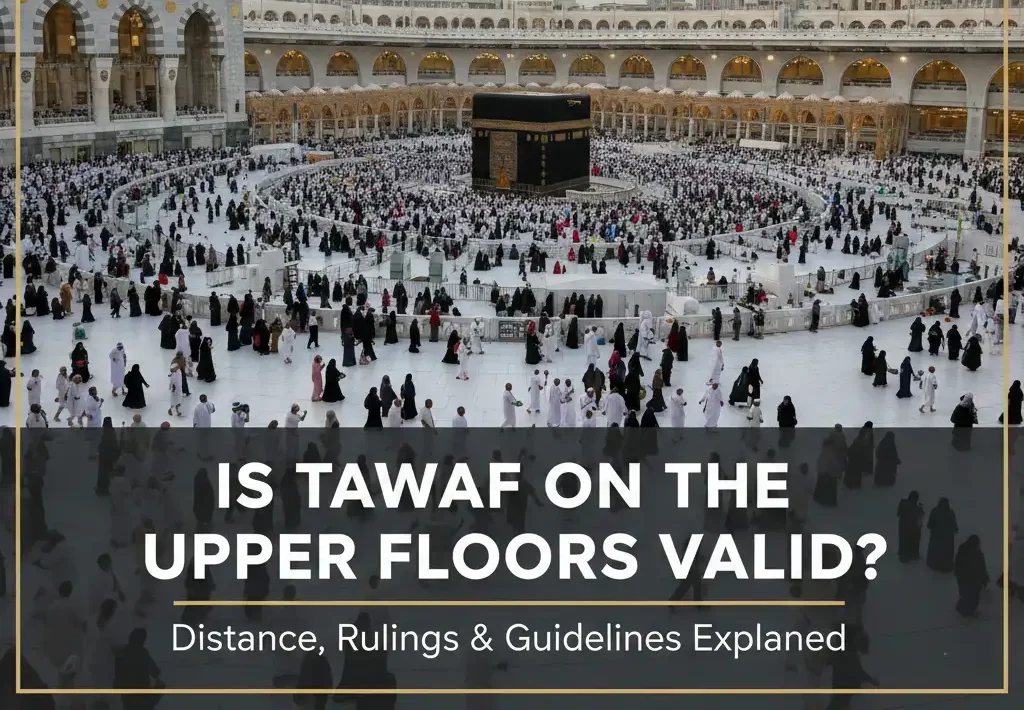
You will face this question many times in Hajj season: can I circumambulate validly on higher floors of the Haram? The millions of UK pilgrims who wonder if undertaking Tawaf on the roof levels constitutes their complete circumambulation. Knowing that the jurists agree on this helps keep your worship truly valid and legally permissible for you, all throughout your stay in pilgrimage.
The Islamic Ruling on Upper Level Tawaf
Tawaf may be performed on any level inside Masjid al Haram. Scholars state that a tawaf performed inside the mosque is valid whether it is done on a lower floor or an upper floor. Sa’y is a separate rite with its own rulings and is performed in the Mas’a, not in the tawaf area, so the two should not be confused.
What Do Islamic Scholars Agree On?
The Permanent Committee for Islamic Research and Fatwa ruled that tawaf performed from an upper floor of the Haram is correct, a ruling given in the context of severe overcrowding. Some scholars had objected because the upper floors sit higher than the Kaaba itself, and the Committee addressed that objection directly. There is no difference for Umrah whether you are doing it on your own or with the facilities provided by Hajj packages expert guides. The allowance is grounded in certain geographic and physical principles, as opposed to random limits.
You will discover that experts extend permission based on the concept of an area having height as well as width. The sacredness of the Haram extends to the airspace around the Kaaba, and upper levels are included when people make tawaf there. Your Hajj packages provider should explain this ruling, because some pilgrims still doubt the validity of tawaf on an upper floor and repeat a tawaf that was already sound.
You have to remember that this kind of permission is accompanied by conditions. Just because you are allowed to perform tawaf upstairs doesn’t mean every elevated spot is now fair game. You cannot perform tawaf properly on the rooftops of random buildings surrounding the Haram. The authorisation is a direct mandate for use of the Haram’s validated upper floors and galleries.
Valid Tawaf on Upper Levels: Conditions and Necessity
Direct Vertical Orientation Prerequisites
You must realise that your location when performing tawaf on the top floor needs to be perpendicular over the path of circumambulation, and you cannot stand on a slope. You will not be able to roam around horizontally, leaving the conventional tawaf course from upper floors. This principle of alignment serves to avoid simply wandering randomly over the Kaaba.
You must imagine an imaginary cylinder rising from the tawaf course around the Kaaba. Your upper storey position also needs to be inside this virtual projection downwards. You will notice these boundaries clearly marked by separate upper level tawaf areas for pilgrims to perform the engagement of tawaf at the Haram, so that they do not get confused or worship in an invalid manner.
You are not allowed to do tawaf on any upper floor if there is an architectural addition or barrier that prevents you from maintaining the vertical nature of your circles. You have to verify your walking track lies outwardly onto the established tawaf circuit from an overhead perspective.
Maintaining the Seven Circuits Mandate
During your upper floor tawaf, you will have to do seven complete circuits, just as on the ground level. You need to watch and count your rounds since the high angle perspective and distance perception can be deceiving. Your Umrah packages agency will often reiterate this mandatory requirement.
You don’t mix ground floor and upper floor circuits in a single tawaf. You should plan in advance whether you’ll do all seven rounds on one level, or perform multiple complete tawafs at different elevations. That helps keep your worship spiritually pure.
Please be advised that scholars have agreed that you could do tawafs, some on the bottom and others at the higher levels, though each tawaf must be complete and distinct. You can’t do four circuits downstairs and then wrap up on the upper floors as a single tawaf.
Distance in Terms of Tawaf on an Upper Floor
| Level | One circuit | Seven circuits |
|---|---|---|
| Ground floor, closest to the Kaaba | about 80 metres | about 0.6 km |
| Ground floor, middle of the mataf | about 150 to 250 metres | about 1 to 1.8 km |
| Ground floor, outer edge | about 300 to 400 metres | about 2.1 to 2.8 km |
| First floor | about 280 to 300 metres | about 2 km |
| Second floor | about 400 metres | about 2.8 km |
| Roof, the third level | about 500 to 750 metres | about 3.5 to 5.2 km |
Published figures differ from one source to another because the length of a circuit depends on how far you stand from the Kaaba, not on the floor alone. Walk close in and your circle is short. Walk near the outer railing of the same level and it is far longer. The four sides of the Kaaba measure 9.90, 12.04, 10.18 and 11.68 metres, a perimeter of about 43.80 metres, and tawaf must pass outside the Hijr Ismail, so the shortest realistic circuit is around 80 metres.
How Distance Measurements Are Applied
You’ll find yourself speculating about whether walking the circle of an upper floor is different from ground level tawaf. That depends on exactly where you are in the upper decks. These are built in curves, so the distances referenced are assumed according to both floor level and radial position.
You should know that maintaining a correct standing position will put you at the right distance from al Ka’bah. You cannot just take any path on the upper floor and say it is valid, as your path should correspond to where tawaf happens at ground level.
You might want to know that some upper floor paths get you closer to the Kaaba than the traditional ground level circuit. This closeness doesn’t cancel your tawaf. Scholars acknowledge that proximity to the holy sanctuary remains spiritually valuable. Your package provider can clarify how distances are calculated for earmarked upper floor spaces.
Architectural Variations and Distance Scaling
You’ll notice that modern expansions of the Haram added several upper floor galleries at slightly different distances from the Kaaba. Your path must remain consistent across all seven circuits. You can’t adjust your distance between rounds on different gallery sections.
You need to choose one upper floor level as the starting point of your tawaf and complete all seven circuits there without switching floors mid worship. This ensures your tawaf retains spiritual soundness and physical manageability.
Practical Rulings Concerning Tawaf on Upper Stories
When Tawaf on the Upper Floor Becomes Necessary
Upper floors become especially useful when ground level crowding becomes dangerous, particularly during peak pilgrimage periods. Preservation of physical safety takes precedence. Attempting actions such as kissing the Black Stone when it leads to harm invalidates the spirit of worship when focus on remembrance is lost.
Elderly, infirm, or physically limited pilgrims often find upper floors safer and more manageable. Many pilgrims with special needs perform valid sa’is and tawafs upstairs with better focus than they could at ground level.
Women pilgrims also choose upper galleries for comfort and security during crowded hours. Many pilgrims find the upper levels calmer during peak hours.
Arrangements Before Tawaf on High Floors
You must be in wudu before you begin your tawaf. Ablution facilities are available within the mosque complex, so make wudu before you start rather than after you have begun. If your wudu breaks during tawaf, stop and renew it, then ask your group scholar how to resume, because the schools of fiqh differ on whether you continue or begin again.
Ihram rules remain unchanged at higher elevations. You cannot adjust clothing or relax restrictions because you are above ground level. Religious duties do not change with altitude.
Arriving early helps you secure a suitable section of the upper floor. Observing your intended path beforehand and setting mental landmarks helps maintain consistency across all seven rounds.
Common Misconceptions About Upper Floor Tawaf
The Vertical Alignment Misconception
Not every upper floor spot qualifies for tawaf, even within Haram boundaries. Vertical alignment with the ground level circuit is mandatory. Random upper locations are invalid.
Validity does not change with height, as long as every condition of tawaf is met. Being nearer the Kaaba is generally regarded as more virtuous, so most pilgrims who are able will prefer the ground floor. That is a matter of virtue, not validity. A calm and complete tawaf upstairs is better than an unsafe one below.
The Multiple Floor Myth
A single tawaf cannot span multiple floors. All seven circuits must be completed on one level. Performing partial rounds on different floors renders the tawaf invalid.
Designated Upper Floor Zones in the Haram
Official Tawaf Areas
The upper floors have marked tawaf routes, and stewards direct pilgrims to the areas that are open at that time. Access points and open levels change with the season and the crowd, so follow the signage and the stewards on the day. Hajj package guides usually direct pilgrims to these approved areas.
Avoid makeshift or undesignated sections. Official design ensures correct vertical alignment and lawful worship.
Obey signage and barriers. These architectural limits directly affect the validity of worship, and respecting them reflects adherence to religious authority.
Women Specific Upper Floor Sections
Some areas and timings are managed to give women more space during the busiest hours. Arrangements vary by season, so check with your guide on arrival. These areas offer safety, comfort, and focus. Umrah packages often advise on optimal times for reduced crowd density.
Conclusion Guidance on Sa’y and Upper Floor Tawaf
Upper floor tawaf is a valid alternative to ground level circumambulation, endorsed by scholars. Your Hajj packages provider can guide you toward the most suitable options. Barakah remains the same when tawaf meets all shari’ah conditions.
Maintain vertical alignment, complete all seven circuits on one level, perform wudu beforehand, and respect Haram boundaries. These requirements ensure worship fulfills both legal and spiritual objectives.
You will complete your Umrah or Hajj confident that your upper floor tawaf holds full validity. Your commitment to correct practice reflects reverence for Islamic teachings and the sanctity of pilgrimage.
Rulings referenced above: the conditions of tawaf and its validity on the upper and lower floors of the mosque, Islam Question and Answer fatwa 253569; and the ruling of the Permanent Committee on tawaf from the upper floor, recorded in Fatawa Islamiyyah, Volume 4, page 174. Kaaba measurements from Saudipedia.