
The niyyah for Umrah is your intention to perform Umrah for Allah. You make it at or just before the Miqat, after putting on Ihram. Say in Arabic: Labbayk Allahumma Umrah (O Allah, here I am for Umrah), or in English: “O Allah, I intend to perform Umrah.”
Niyyah for Umrah: The Intention That Starts Your Pilgrimage
Niyyah (intention) is the spiritual switch that turns your journey into Umrah. Without it, you’re just travelling in special clothes. With it, every step becomes worship.
For UK pilgrims, the most common confusion isn’t the words. It’s the timing. When exactly do you say it? What if you’re on a plane? What if you forget? This guide walks you through the exact wording, the right moment, and what to do if things don’t go perfectly, and if you’re still finalising your trip, browse current Umrah package deals from the UK.
if you’re still finalising your trip.
The primary keyword here is straightforward: niyyah for umrah. But the real question underneath is “How do I get this right so my Umrah counts?”
What Is Niyyah and Why Does It Matter?
Niyyah means intention in the heart to perform an act of worship for Allah’s sake. In Islamic jurisprudence, actions are judged by intentions. That’s why the Prophet Muhammad (peace be upon him) said: “Actions are by intentions, and every person will have only what they intended.”
For Umrah, niyyah marks your entry into the sacred state of Ihram. It’s not a prayer you recite at the Kaaba. It’s the moment you commit, in your heart and optionally with your tongue, that you’re now performing Umrah.
What often gets missed is this: niyyah is internal. Saying the words out loud is recommended (mustahabb) and helps focus the heart, but the core requirement is the sincere intention within.
The Exact Words: Arabic, Transliteration, and English
There are two commonly used formulations. Both are valid. Pick the one you can remember and say with presence of heart.
Option 1 (Short, From the Sunnah)
Arabic:
لَبَّيْكَ اللَّهُمَّ عُمْرَةً
Transliteration:
Labbayk Allahumma Umrah
Meaning:
O Allah, here I am for Umrah.
Option 2 (Longer, With a Request for Ease and Acceptance)
Arabic:
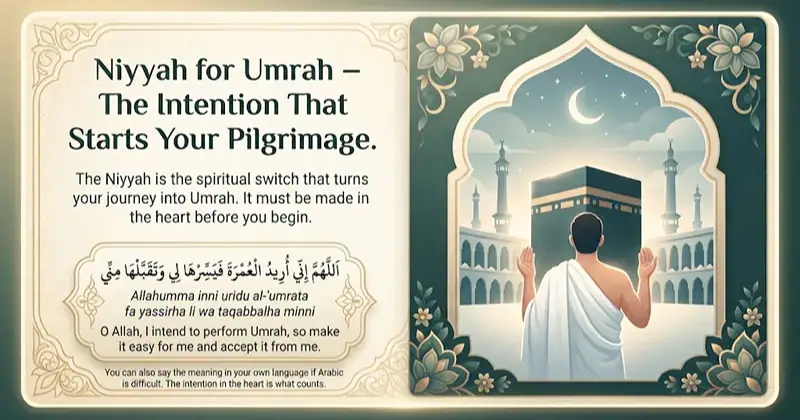
اللَّهُمَّ إِنِّي أُرِيدُ الْعُمْرَةَ فَيَسِّرْهَا لِي وَتَقَبَّلْهَا مِنِّي
Transliteration:
Allahumma inni uridu al-‘umrata fa yassirha li wa taqabbalha minni
Meaning:
O Allah, I intend to perform Umrah, so make it easy for me and accept it from me.
You can also say the meaning in your own language if Arabic is difficult. The intention in the heart is what counts.
When to Make Niyyah for Umrah (With UK Flight Timing)
This is where most UK pilgrims get unsure. The rule is simple in principle, trickier in practice.
The rule: Make niyyah at the Miqat, or just before reaching it, after you’ve put on your Ihram garments.
The Miqat is a designated boundary around Makkah. You cannot cross it in a state of travel for Umrah or Hajj without being in Ihram and having made niyyah.
For UK travellers flying direct to Jeddah or Madinah, the relevant Miqat points are:
- Dhul Hulayfah (Abyar Ali) — for those coming from or via Madinah
- Juhfah (or nearby Rabigh) — for those coming from the north-west (many UK flights cross near here)
- Qarn al-Manazil — for those coming from the east (via Riyadh or Dammam)
- Yalamlam — for those coming from the south
Airlines usually announce when you’re approaching the Miqat. That’s your cue.
Practical Timeline for a UK Pilgrim
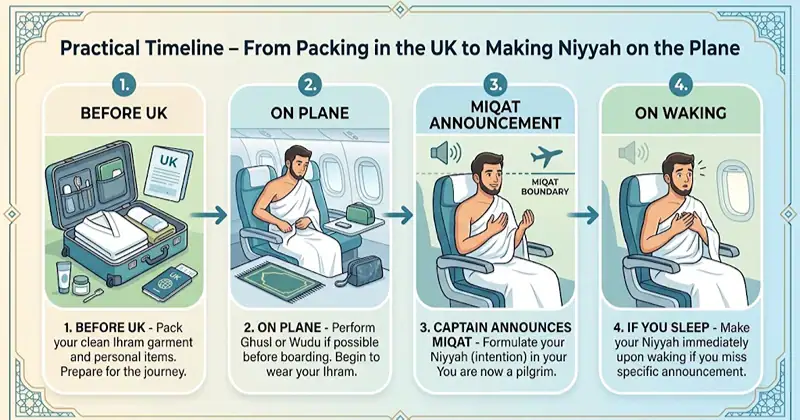
- Before leaving the UK: Pack your Ihram clothes. Some people wear them at home. Others change on the plane. Both are fine as long as you’re in Ihram before the Miqat.
- On the plane: Perform ghusl or wudu if you can. Put on your Ihram (men: two unstitched sheets; women: modest loose clothing covering the body, hands and face may remain uncovered according to most scholars).
- When the captain announces the Miqat: Make your niyyah. Say the dua. Then begin the Talbiyah.
- If you sleep through the announcement: Make niyyah as soon as you wake, even if you’ve passed the Miqat. You do not owe a sacrifice for a delayed niyyah if it was unintentional, but you should make it immediately upon remembering.
In practice, the most common mistake is making niyyah too early, before wearing Ihram, or too late, after crossing the Miqat without any intention. Aim for the window just before the boundary.
Niyyah vs Talbiyah: What’s the Difference?
People mix these up constantly.
Niyyah is your intention: “I am now performing Umrah.”
Talbiyah is your response to Allah’s call, recited repeatedly after niyyah until you start Tawaf: Labbayk Allahumma Labbayk…
Sequence matters: niyyah first, then Talbiyah. You don’t have to say Talbiyah out loud, but it’s highly recommended and was the practice of the Prophet (peace be upon him).
Step-by-Step: Making Niyyah Correctly
Here’s a concise checklist you can screenshot or print, drawn from our step-by-step Umrah guide for first-timers.
| Step | What to Do | Notes |
|---|---|---|
| 1 | Perform ghusl or wudu | Recommended, not mandatory |
| 2 | Put on Ihram garments | Men: two sheets; Women: modest loose clothing |
| 3 | Pray 2 rak’ahs (optional) | Sunnah, not required for niyyah itself |
| 4 | Face the Qibla (if on ground) | On a plane, face forward or towards Makkah if known |
| 5 | Make niyyah in the heart | Say the Arabic or English dua out loud if you can |
| 6 | Begin Talbiyah | Repeat until you start Tawaf |
Common Scenarios and What to Do
You made niyyah before the Miqat.
If you did it after wearing Ihram and close to the Miqat, you’re fine. If it was long before (e.g., at home in the UK), renew your intention at the Miqat to be safe.
You crossed the Miqat without niyyah.
Make it immediately when you remember. There’s no penalty for an honest mistake, but don’t delay once you know.
You’re already in Makkah and want to do Umrah.
Go to the nearest Miqat boundary (for many, this is Al-Hill area like Ji’ranah or Tan’im), enter Ihram there, and make niyyah. You cannot start Umrah from inside the Haram boundary without this.
You’re doing Umrah multiple times in one trip.
Each Umrah requires a fresh niyyah and Ihram from a Miqat or Hill boundary.
Getting Support With Niyyah and Miqat Timing
If you are travelling from Birmingham, London, or Manchester, you may want a guide. They will help with the Miqat announcement, niyyah timing, and your first Tawaf.
Our UK Hajj & Umrah travel agency offers briefings before you leave. We also give support on the ground in Makkah. We don’t replace scholarship, but we do remove the guesswork for first-timers.
FAQ
What Is the Niyyah for Umrah in Arabic and English?
The short form is Labbayk Allahumma Umrah (O Allah, here I am for Umrah). A longer version is Allahumma inni uridu al-‘umrata fa yassirha li wa taqabbalha minni (O Allah, I intend Umrah, make it easy and accept it).
When Exactly Should I Make Niyyah for Umrah?
At or just before the Miqat, after you’ve put on your Ihram garments. On a flight, wait for the captain’s Miqat announcement.
Can I Say the Niyyah in English Instead of Arabic?
Yes. The intention is in the heart. Arabic is recommended, but English meaning is valid if you cannot manage the Arabic words.
Do I Need to Pray Two Rak’ahs Before Making Niyyah?
It’s Sunnah and recommended, but not a condition for the niyyah itself. If you miss it, your niyyah is still valid.
What if I Make Niyyah Before Reaching the Miqat?
If it’s close to the Miqat and after wearing Ihram, you’re fine. If it’s long before (e.g., at home), renew your intention at the Miqat to align with the Sunnah timing.
Is Verbal Niyyah Required or Is Intention in the Heart Enough?
Intention in the heart is the core requirement. Saying it out loud is recommended and helps focus, but not mandatory.
Final Thoughts
Niyyah for Umrah is simple in essence: mean it in your heart, say it with your tongue if you can, and time it at the Miqat. The rest of your Umrah flows from that moment.
If you’d like a printed dua card with the Arabic, transliteration, and English meaning, or a short audio recap to listen to on the plane, get in touch. We’ve helped hundreds of UK pilgrims get this first step right, and we’re happy to share the same resources with you.