By Anaya Noor, Senior Travel Writer and Hajj & Umrah Specialist
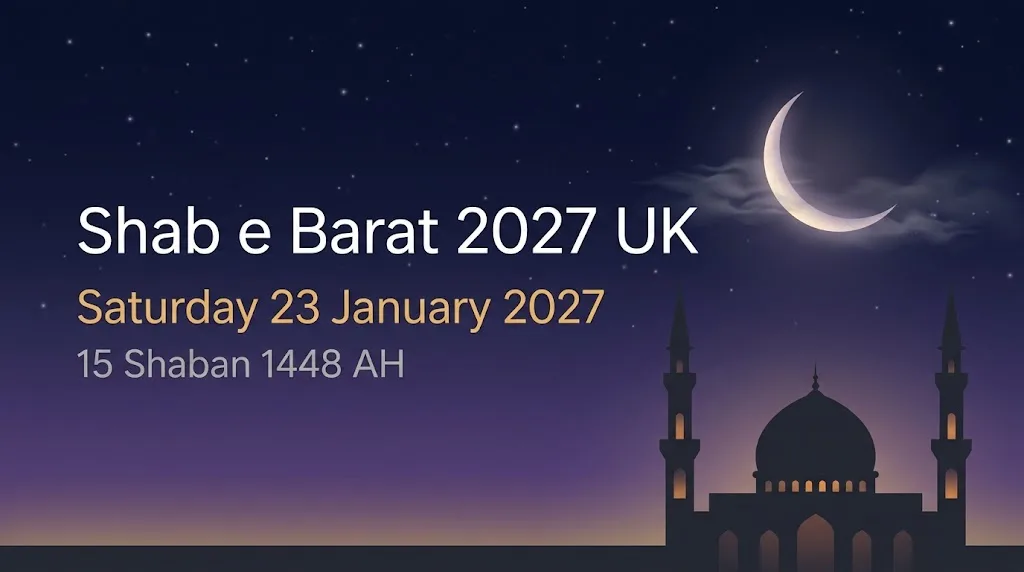
Shab e Barat 2027 in the UK falls on the night of Saturday 23 January, beginning after Maghrib and running until Fajr on Sunday 24 January. That corresponds to 15 Shaban 1448. Confirmation rests on the Shaban moon sighting, so the whole thing may shift forward by a day.
Shaban leads straight into Ramadan, which is why so many families treat this night as the turning point in their preparation. If travel is part of your plan this year, our Umrah packages from the UK set out what’s available and which dates fill first.
Shab e Barat 2027 Date in the UK
Here’s the thing most listings get wrong. They print a single date and leave you guessing whether that means the evening or the following day.
| What | When |
|---|---|
| 1 Shaban 1448 begins | Around Sunday 10 January 2027 |
| The night itself, 14 into 15 Shaban | Saturday 23 January 2027, from Maghrib |
| Night ends | Fajr, Sunday 24 January 2027 |
| Day of 15 Shaban, optional fast | Sunday 24 January 2027 |
| If the Shaban crescent is sighted a day later | Everything moves to Sunday 24 into Monday 25 January |
In Islam a day starts at sunset, not midnight. So the night of 15 Shaban actually arrives on the evening of the 14th. People book time off for the wrong day fairly regularly because of this.
A Saturday night is convenient, as it happens. Nobody’s rushing to work the next morning, which matters more than you’d think when the night runs as long as it does in January.
Timings: Why a UK Winter Night Changes Everything
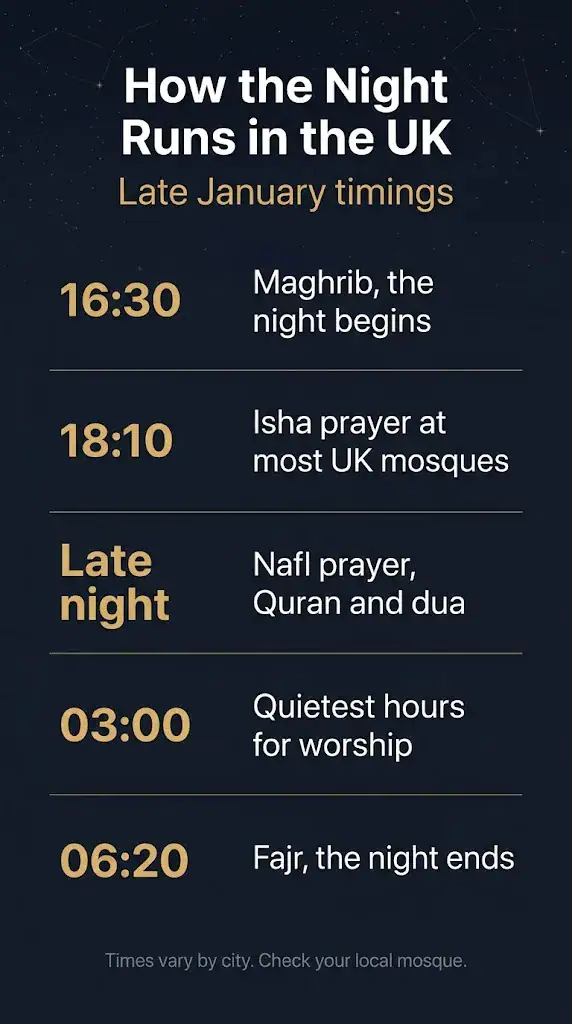
Late January in Britain means Maghrib around half four in the afternoon. Fajr won’t come until roughly six the next morning.
Sixteen hours of night. Give or take, depending on whether you’re in London, Birmingham, Manchester, Leeds or Glasgow, and Scotland runs noticeably longer.
Compare that with Pakistan or Bangladesh, where the same night runs maybe eleven or twelve hours. Families who grew up observing Shab e Barat back home often plan as though the night is short, then find themselves with hours to spare at two in the morning and no real plan for them.
Pace yourself. Rest after Isha if you intend to pray late. A long night sounds like a gift until you’re half asleep by midnight and the best part is still ahead.
Check your local mosque timetable for exact Maghrib and Fajr in your city, because the difference between Glasgow and London is close to forty minutes at that time of year.
Significance of 15th Shaban
Shaban is the eighth month of the Islamic calendar, sitting between Rajab and Ramadan. Reports in the hadith collections describe the Prophet ﷺ fasting more in Shaban than in any other month outside Ramadan.
The night of mid Shaban, known as Nisf Shaban or Laylat al Bara’ah in Arabic, is widely observed as a night of forgiveness. Narrations describe Allah turning in mercy towards His creation on this night and forgiving those who seek it, with exceptions for those holding on to grudges or associating partners with Allah.
Across South Asia it’s Shab e Barat. Turkish Muslims call it Berat Kandili. In Malaysia and Indonesia you’ll hear Nisfu Syaban. Same night, different names.
Where Scholars Actually Disagree
This part gets glossed over on most UK pages, and that’s a shame, because British mosques genuinely differ and readers deserve to know why.
| Position | What it holds |
|---|---|
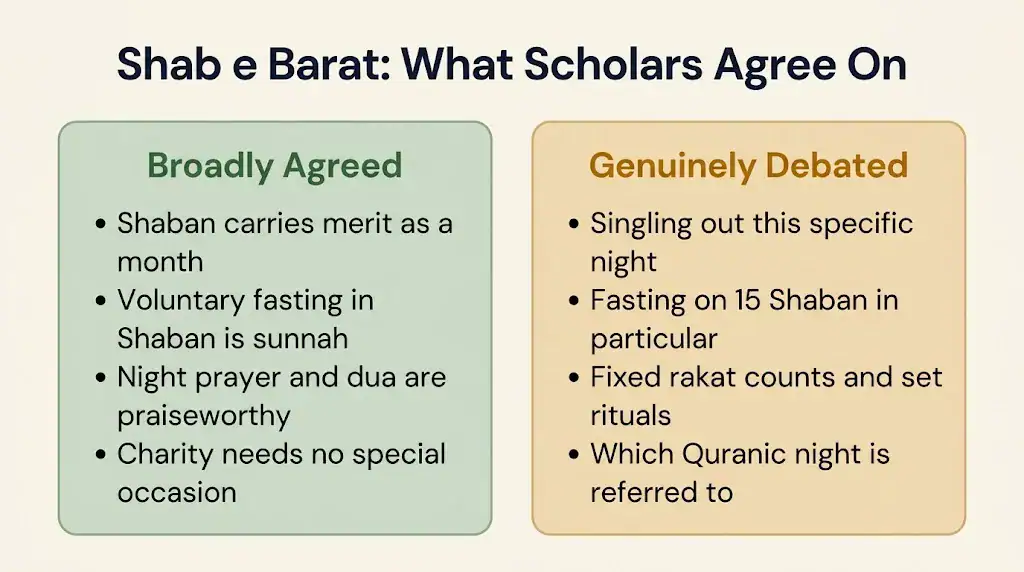
| Widely accepted | Shaban carries merit, and voluntary fasting during the month is established sunnah |
| Widely accepted | Individual night prayer, dua and seeking forgiveness are always praiseworthy |
| Debated | Whether the narrations about mid Shaban are strong enough to single the night out |
| Debated | Fasting specifically on 15 Shaban, since some scholars hold no sound hadith singles out that day |
| Generally discouraged | Fixed congregational rituals with a set number of rakats and specific recitations, which many scholars consider later additions |
Many Hanafi and traditionalist scholars affirm the night’s status and encourage worship on it. Others, broadly in the Salafi tradition, accept that extra worship is good while rejecting the specific customs built around it.
What practically everyone agrees on? Praying at night, making dua, reciting Quran and giving charity are good on any night of the year. Nobody argues against that.
If you follow a particular madhhab or your family mosque has a settled position, go with it. This isn’t a question a blog settles for you.
Shab e Barat Dua and Ibadat
No fixed formula has been transmitted for this night. That surprises people who’ve grown up seeing printed dua cards handed out at the mosque.
What’s recommended is what’s recommended on any blessed night.
Istighfar, asking forgiveness, sincerely and repeatedly. Nafl prayer, whatever number you can manage without burning out. Quran recitation, even a short portion read properly. Dua for yourself, your parents, your children and the wider ummah. Salawat on the Prophet ﷺ.
One thing worth doing before the night starts: clear any grudges. The narration about mid Shaban specifically mentions people who harbour resentment towards others. A text message to a relative you’ve fallen out with might be the most valuable act of the whole night.
Shab e Barat Namaz
You’ll see claimed formats online, usually a hundred rakats with Surah Al Ikhlas repeated a set number of times. These specific structures aren’t established in the authentic sunnah, and scholars across several traditions have cautioned against treating them as prescribed.
Pray nafl, as much or as little as your energy allows. Two rakats prayed with full attention beat fifty rushed ones.
Charity and sadaqah
Giving on blessed nights is a long standing practice. UK Muslims tend to donate through their local mosque or a registered charity, and plenty of organisations run appeals around this date.
Quick practical note. If you’re gift aiding a donation, do it before the end of the tax year rather than leaving it to the last week of Ramadan when charity websites crawl under load.
Fasting on 15 Shaban
Many UK families fast on 15 Shaban, which in 2027 means Sunday 24 January.
Scholarly opinion splits here. Some hold the narration recommending it is sound enough to act on. Others hold that no authentic hadith singles out that specific day, so fasting it as a prescribed practice has no clear basis.
Both camps agree that fasting during Shaban generally is established and recommended, which is a useful way through the disagreement. The 13th, 14th and 15th of each lunar month are the Ayyam al Beed, the white days, and fasting those is sunnah regardless of which month you’re in.
Avoid fasting in the last day or two before Ramadan, though. That’s a separate ruling and most scholars discourage it.
Grave Visiting in the UK: The Bit Nobody Mentions
Visiting graves on Shab e Barat is deeply rooted in South Asian practice. Back home, cemeteries stay open and families go after Isha.
British cemeteries don’t work like that.
Most council run cemeteries lock their gates at dusk, which in late January is before five in the afternoon. Some Muslim burial sections operate separate arrangements, and certain mosques negotiate extended access for particular nights, but you can’t assume it.
What often gets missed is that turning up to locked gates with elderly relatives in the car is avoidable. Ring the cemetery office or your mosque a week ahead. Several UK councils publish winter closing times online, and a number of Muslim burial trusts arrange specific visiting windows.
If access isn’t possible, dua for the deceased works perfectly well from home. Nothing is lost.
Is Shab e Barat a Public Holiday in the UK?
No. There’s no UK bank holiday for Shab e Barat, and none is likely.
Falling on a Saturday night in 2027 does solve the main problem. You won’t need leave for the night itself, and the Sunday fast lands on a day most people aren’t working anyway.
Shift workers are the exception. If you’re on a Sunday rota and planning to fast, a short winter day makes it manageable. Sunrise to sunset in late January is barely eight hours.
Shab e Barat and Ramadan 2027
Mid Shaban sits roughly two weeks before Ramadan. Ramadan 1448 is expected to begin around Monday 8 February 2027.
Which makes this night a natural checkpoint. Scholars have long described Shaban as the month for getting your worship into shape before Ramadan arrives, rather than starting cold on the first fast.
It’s also the point at which Umrah travel plans stop being hypothetical. Ramadan is the busiest pilgrimage season of the year, and the last ten nights go first by a wide margin. If Ramadan Umrah packages are on your mind, two weeks out is already late for the peak dates. Aqdas Travel arranges pilgrimage trips for Muslims across the UK and we’re ATOL protected under licence 12834.
Common Questions
When is Shab e Barat 2027 in the UK?
The night of Saturday 23 January 2027, starting at Maghrib and ending at Fajr on Sunday 24 January. That’s 15 Shaban 1448. If the Shaban crescent is sighted a day later than expected, everything moves forward twenty four hours.
Can you fast on Shab e Barat?
Yes, many do, on 15 Shaban itself which falls on Sunday 24 January 2027. Scholars differ on whether that specific day is singled out in authentic narrations, though fasting during Shaban generally is established sunnah and widely encouraged.
Is Shab e Barat a public holiday in the UK?
No. It isn’t a bank holiday anywhere in Britain. In 2027 the night falls on a Saturday, so most people won’t need time off, though shift workers on a Sunday rota may want to plan around the optional fast.
What dua do you read on Shab e Barat?
No specific dua has been transmitted for this night. Istighfar, salawat on the Prophet ﷺ, Quran recitation and personal supplication in your own words are all appropriate. Clearing grudges beforehand carries particular weight given what the narrations mention.
Is Shab e Barat mentioned in the Quran?
Not by that name. Some scholars connect it to the blessed night referred to in Surah Ad Dukhan, while others understand that verse as describing Laylat al Qadr in Ramadan. The interpretation is genuinely contested among qualified scholars.
How many rakats is Shab e Barat namaz?
There’s no fixed number established in the authentic sunnah. Formats circulating online, typically a hundred rakats with set recitations, aren’t traceable to sound narrations. Pray whatever nafl you can manage with proper concentration instead.
Before the Night Arrives
Check your mosque’s announcement in the days after the Shaban moon sighting, since that confirms whether the night falls on the 23rd or shifts to the 24th. Look up Maghrib and Fajr for your own city rather than relying on a national average. Ring ahead about cemetery access if grave visiting is part of your family’s practice.
Then plan the night realistically. Sixteen hours is a long stretch, and arriving exhausted at Fajr having done very little is the most common outcome by far.
One honest note to close on. Practice around this night varies widely between UK communities, and so do the rulings behind it. Nothing here replaces your own mosque or a scholar who knows your madhhab. Treat it as preparation for a better conversation, not the final word.