
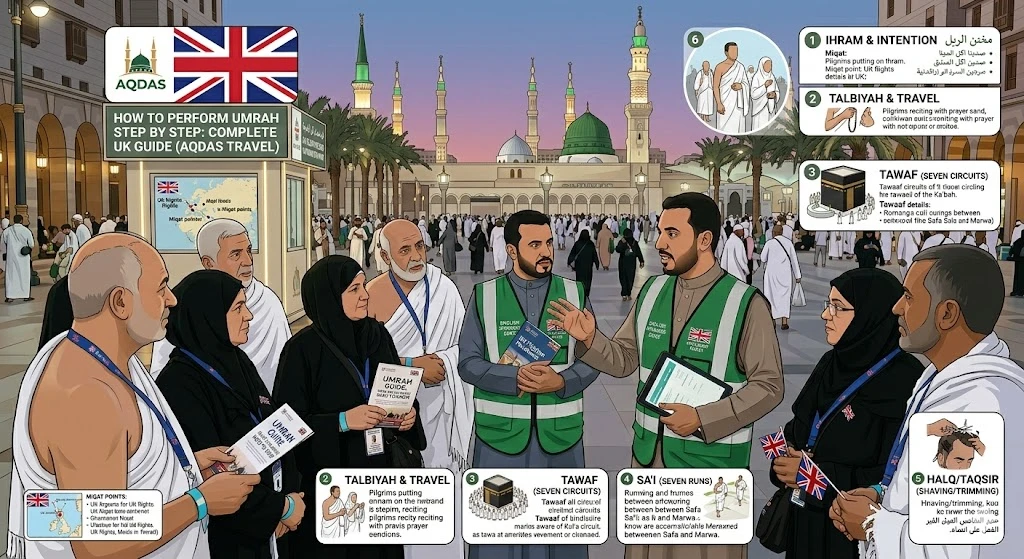
Quick Summary
Umrah is the lesser pilgrimage to Makkah and, unlike Hajj, it can be performed at almost any time of the year. This guide explains how to perform Umrah step by step for UK Muslims, including the four main rituals of Ihram, Tawaf, Sa’i and Halq or Taqsir. You will also find entry requirements, spiritual guidance and common mistakes to avoid. From how to book Umrah packages through to your final prayer, we have covered the journey from scratch with realistic tips that real pilgrims will recognise.
Umrah is one of the most spiritually satisfying journeys you will ever undertake. Whether this is your first time or you have been fortunate enough to go before, understanding how each ritual works transforms the experience from being processed through a schedule into something genuinely life-altering. Aqdas Travel has been the chosen travel agent for thousands of UK pilgrims on this blessed journey, and we are sharing everything you need to know here.
What Is Umrah, and Why Is It Important?
Umrah, sometimes called the minor pilgrimage, is an important act of worship in Islam. The Shafi’i and Hanbali schools hold that it is obligatory once in a lifetime for those who are able, while the Hanafi and Maliki schools regard it as a strongly recommended Sunnah. It involves visiting the holy city of Makkah and performing specific rituals. Unlike Hajj, Umrah has no set date. It can be performed at almost any time of the year, although the Saudi authorities pause Umrah for non-Hajj pilgrims around the Hajj season.
The Prophet (peace be upon him) said: “Umrah to another Umrah is an expiation for what comes between them.” (Sahih al-Bukhari 1773, Sahih Muslim 1349) This points to the spiritual purification and forgiveness connected with this blessed journey.
Umrah is now considerably easier for UK Muslims to perform. Direct flights from London and Manchester (with one-stop options from Birmingham and other UK airports) make travel simpler, Saudi visas for UK nationals can be applied for online, and ATOL protected packages give you financial protection.
The 4 Essential Rites of Umrah (Step by Step)
Quick answer: To perform Umrah, you enter Ihram at or before the Miqat with the intention and the Talbiyah, then perform Tawaf (seven circuits of the Kaaba, anticlockwise), pray two rak’ah, walk seven laps of Sa’i between Safa and Marwah, and finish with Halq or Taqsir. The rituals usually take two to six hours, depending on crowds.
| Step | Ritual | What You Do | Duration |
|---|---|---|---|
| 1 | Ihram | Enter a state of purity and wear the prescribed attire | 5 to 10 minutes |
| 2 | Tawaf | Circle the Kaaba seven times, anticlockwise | Around 1 hour |
| 3 | Sa’i | Walk between the hills of Safa and Marwah seven times | 30 to 45 minutes |
| 4 | Halq or Taqsir | Cut the hair, ending the state of Ihram | 5 to 15 minutes |
Step 1: Entering the State of Ihram
Ihram is not simply an article of clothing. It is a spiritual state of purity and intention. This is how to enter it correctly.
Before your flight:
- Perform Ghusl, the full ritual bath
- Cut your nails and remove unwanted body hair
- Men can put on the two Ihram sheets at home or at the airport, as changing on the plane is difficult
- If time allows, pray two rak’ah before entering Ihram (scholars differ on whether this is a specific Sunnah)
On the plane:
Flights from the UK to Jeddah cross the Miqat boundary before landing. For direct UK flights this is usually near the Miqat of al-Juhfah (close to Rabigh), but routes vary. The crew normally make an announcement in advance, so ask them, or our team, roughly when your flight crosses it and set a phone reminder. At or before the Miqat:
- Men should be wearing the two unstitched white sheets, the Izar and the Rida
- Women dress modestly in loose fitting clothing that covers the whole body, excluding the face and hands
- Make the Niyyah for Umrah, for example “Labbayk Allahumma ‘Umratan” (O Allah, here I am for Umrah). Our Niyyah for Umrah guide gives the full wording. For Hanafis, Ihram begins with the Niyyah together with the Talbiyah
- Begin the Talbiyah: “Labbayk Allahumma labbayk, labbayka la sharika laka labbayk, innal-hamda wan-ni’mata laka wal-mulk, la sharika lak” (Here I am, O Allah, here I am. You have no partner. All praise, blessings and sovereignty belong to You. You have no partner) (Sahih al-Bukhari 1549). Men recite it aloud and women softly
Critical error to avoid: Do not wait until you land in Jeddah. You must either enter Ihram at or before the Miqat, or return to the Miqat to do so. Failing to do either requires Dam, a penalty sacrifice.
Flying to Madinah first? You do not need to be in Ihram on the plane. You enter Ihram at Dhul Hulayfah (Masjid Abyar Ali), on the edge of Madinah, when you travel on to Makkah.
What is not allowed in Ihram:
- Perfume and scented products, including scented soap and wipes
- Cutting or removing hair or nails
- Marital relations and, according to most schools, proposing or entering into a marriage contract
- Hunting land animals
- Men: clothing tailored to the shape of the body, covering the head, and footwear that covers the ankles
- Women: the niqab and, according to most schools, gloves
If you break one of these rules by mistake, ask a scholar what is required, as the ruling depends on what happened.
Step 2: Performing Tawaf
Your heart will stop when you walk into Masjid al-Haram and see the Kaaba for the first time. Let that moment settle before you begin. This is the House of Allah.
How to perform Tawaf:
- Enter Masjid al-Haram with your right foot and say “Allahumma iftah li abwaba rahmatik” (O Allah, open the gates of Your mercy for me) (Sahih Muslim 713)
- Make sure you have wudu before you start. The Maliki, Shafi’i and Hanbali schools treat it as a condition of Tawaf, and Hanafis regard it as wajib
- Men only, Idtiba: for the seven circuits, wear the upper sheet under the right arm so the right shoulder is uncovered. Cover it again before the two rak’ah. It is not worn this way for the rest of Ihram
- Begin at the Black Stone, or Hajar al-Aswad. Kiss or touch it if you can. If the crowd does not allow it, point towards it and say “Bismillah, Allahu Akbar”
- Walk anticlockwise seven times around the Kaaba, keeping the Kaaba on your left
- There are no fixed duas for each circuit. Speak from your heart, in any language
- Men only, Raml: during the first three circuits, walk briskly with short, quick steps and the shoulders raised
- Touch the Yemeni Corner with your right hand if you can reach it, without kissing it. If you cannot, simply carry on. Most scholars say you do not point to it
- Between the Yemeni Corner and the Black Stone, recite the Quranic dua “Rabbana atina fid-dunya hasanatan…” (Quran 2:201; Sunan Abi Dawud 1892)
After completing seven circuits:
- Pray two Rak’ah behind Maqam Ibrahim if possible, or anywhere else in the mosque (Quran 2:125). Many pilgrims recite Surah al-Kafirun and Surah al-Ikhlas in these two rak’ah, following the Prophet’s practice (Sahih Muslim 1218)
- Make dua while drinking Zamzam water
Common mistakes during Tawaf:
- Following group leaders who recite duas loudly, which distracts other worshippers
- Touching and wiping the walls of the Kaaba for blessing. Apart from the Black Stone and the Yemeni Corner, this is not from the Sunnah, although many scholars permit standing at the Multazam to make dua
- Assuming a specific dua must be recited for each circuit, which is not the case
Step 3: Sa’i Between Safa and Marwah
After completing Tawaf and drinking Zamzam, proceed to the hill of Safa to begin Sa’i.
How to perform Sa’i:
- As you approach Safa on the first lap, recite “Inna as-Safa wal-Marwata min sha’a’irillah” (Quran 2:158). Then climb Safa, face the Kaaba and raise your hands in dua. The Prophet (peace be upon him) said: “La ilaha illallahu wahdahu la sharika lah, lahul-mulku wa lahul-hamdu wa huwa ‘ala kulli shay’in qadir. La ilaha illallahu wahdah, anjaza wa’dah, wa nasara ‘abdah, wa hazamal-ahzaba wahdah” (Sahih Muslim 1218), and repeated the same at Marwah
- Walk down towards Marwah. This is circuit one
- Between the green lights, men jog and women walk normally
- Continue to Marwah, turn to face the Kaaba and make dua
- Return to Safa. This is circuit two
- Complete seven circuits in total, finishing at Marwah
Practical tip: Sa’i can be demanding, particularly in the heat of a Saudi summer. Pace yourself, keep drinking water and do not rush. There is no additional reward for finishing quickly. Wudu is recommended for Sa’i, but most scholars do not require it.
Step 4: Halq or Taqsir (Hair Cutting)
The final step releases you from the restrictions of Ihram.
- Men: shaving the head completely, Halq, is preferred over trimming, Taqsir
- Women: trim about a fingertip’s length from the ends of the hair. The schools differ on how much of the hair this applies to, so follow your madhhab
Barbers operate throughout the area surrounding the Haram. Agree the price before the barber starts. Once this is done you may change into ordinary clothing, as all Ihram restrictions are now lifted.
Your Umrah is complete.
Umrah for Women and Men: Key Differences
| Rule | Men | Women |
|---|---|---|
| Ihram clothing | Two unstitched white sheets, with footwear that leaves the ankles uncovered | Ordinary modest clothing in any colour, with socks and shoes allowed. No niqab or gloves |
| Talbiyah | Recited aloud | Recited softly |
| Idtiba and Raml in Tawaf | Yes | No |
| Green lights in Sa’i | Jog | Walk normally |
| Hair | Halq (shaving) preferred, or Taqsir | Taqsir only, about a fingertip’s length |
A woman can enter Ihram during her period and wait until she is pure before performing Tawaf. Our guide to Umrah for women from the UK covers travel, mahram rules and practical tips.
How to Prepare for Umrah From the UK
Entry Requirements
According to the FCDO, UK nationals can perform Umrah outside the Hajj season on an Electronic Travel Authorisation (ETA) or an electronic visa waiver. The FCDO lists the e-visa for tourists only. Requirements are set by the Saudi authorities and can change, so check the FCDO entry requirements and confirm the current position with our team before you book.
| Requirement | Details |
|---|---|
| Entry options | ETA or electronic visa waiver, both listed by the FCDO for Umrah outside the Hajj season |
| Validity and stay | ETA: 730 days, multiple entries, up to 180 days in total. Visa waiver: single entry, up to 180 days |
| When to apply | Well before you fly. The visa waiver must be applied for at least 48 hours, and no more than 90 days, before your flight |
| Passport | Valid for at least 6 months from your arrival date |
| Mandatory vaccination | Meningitis ACWY certificate, vaccinated at least 10 days before arrival |
Important: As soon as your visa or authorisation is issued, download the Nusuk app. You use it for the permits you may need during your trip, including your Rawdah visit in Madinah.
Physical Preparation
Umrah involves a great deal of walking, which can reach 10 to 15 kilometres a day. Begin preparing at least one month before departure.
- Daily walks of 30 to 45 minutes
- Practise climbing stairs, which mirrors Safa and Marwah
- Stay well hydrated
- Eat balanced meals in the weeks before you travel
If you are managing a long term health condition, speak to your GP before booking and let our team know so we can make appropriate arrangements. Our guide to performing Umrah with chronic health conditions covers this in detail.
Spiritual Preparation
- Learn the rituals thoroughly before you travel, through videos and written guides
- Prepare a written dua list for Tawaf, Sa’i and Multazam
- Seek forgiveness from family and friends
- Settle any outstanding debts before departure
- Set a pure intention, as this journey is for Allah alone
Essential Packing List
Items to bring:
- Ihram clothing: two to three sets for men, modest abayas for women
- Comfortable walking shoes, well broken in before you fly
- A small dua book, or a phone app with duas
- Portable charger. UK plugs normally fit Saudi sockets, but a universal adapter is a useful backup
- Unscented toiletries, as perfume is not permitted in Ihram
- Basic medication such as paracetamol, anti-diarrhoeal tablets and plasters
- A small backpack for daily essentials
- A money belt or secure pouch for your passport and cash
Do not overpack: Luggage space is limited and almost everything is available to buy in Makkah and Madinah.
10 Common Mistakes During Umrah
1. Not Booking with an ATOL Protected Agency
Make sure your money is protected by booking with an ATOL licensed operator. Aqdas Travel holds ATOL licence 12834.
2. Entering Ihram Too Late
Many first-timers wait until they reach Jeddah. Enter Ihram before passing the Miqat, which is usually announced on board.
3. Rushing Through the Rituals
Umrah is not a race. Take your time, reflect, and make sincere duas throughout Tawaf and Sa’i.
4. Following Loud Group Leaders
Tawaf and Sa’i are private conversations with Allah. Avoid groups that recite duas in chorus, as it distracts others.
5. Neglecting Physical Fitness
Poor stamina makes the rituals exhausting. Build your fitness in the weeks before departure.
6. Not Downloading the Nusuk App Early
Rawdah visit times fill quickly. Download and register as soon as your visa or authorisation is issued.
7. Believing Duas Are Only Accepted at First Sight of the Kaaba
This is a widely repeated myth with no established basis. Make dua throughout your journey, not only at that first moment.
8. Excessive Shopping
Focus on worship first. There will be time to shop once your rituals are complete.
9. Ignoring Local Customs
Show consideration for Saudi norms: dress modestly, avoid public displays of affection and respect gender-segregated areas.
10. Not Spending Enough Time in Madinah
Many pilgrims rush through Madinah. Set aside two to three days for Masjid an-Nabawi, Masjid Quba and Uhud. Our guide on how to visit Masjid Quba explains the timings and the reward attached to praying there.
The Best Time to Perform Umrah From the UK
| Period | Weather | Crowd Level | Cost | Best For |
|---|---|---|---|---|
| November to February (outside Ramadan) | Milder, daytime highs around 30 to 35°C | Moderate | Medium | Families and first-timers |
| Ramadan | Warm | Very high | High | Maximum spiritual reward |
| June to August | Extreme, 40°C and above | Low | Low | Heat-experienced budget travellers only |
| December | Pleasant | High | High | UK school holidays |
For winter departures, compare our December Umrah packages and January Umrah packages.
Frequently Asked Questions
How Long Does It Take to Perform Umrah?
The core rituals usually take around two to three hours when the Haram is quiet, and four to six hours or more at busy times such as Ramadan or Fridays. Most pilgrims book packages of 7 to 14 nights to allow time for additional prayers, Ziyarat tours and a stay in Madinah.
Can I Perform Umrah While Menstruating?
Tawaf cannot be performed during menstruation, which means Umrah cannot be completed until the period ends. You can still enter Ihram during your period and wait until you are pure to perform Tawaf. Scholars differ on whether entering the mosque itself is permitted. Plan your travel dates around this where possible, and consult a qualified scholar if your circumstances change once you have arrived.
As a Woman, Do I Need to Be Accompanied by a Mahram?
Saudi Arabia has removed the mahram requirement for Umrah, so women may travel without a male guardian. Many scholars still advise a woman to travel with a mahram, so speak to your scholar. If you travel without one, an organised group can make the journey easier, particularly for a first pilgrimage, and we can arrange this for you.
How Is Umrah Different From Hajj?
Hajj is one of the Five Pillars of Islam and must be undertaken at least once in a lifetime by every Muslim who is able. Umrah involves fewer rites and can be performed at almost any time of year. Scholars differ on whether it is obligatory once in a lifetime or a strongly recommended Sunnah.
Can I Perform Umrah More Than Once in a Single Journey?
Yes, although quality matters more than quantity. Many scholars advise performing additional voluntary Tawaf rather than repeatedly re-entering Ihram for further Umrahs.
How Much Does Umrah Cost From the UK?
At the time of writing, our Umrah packages start from £525 per person for 7 nights in 3-star hotels, with 5-star packages from £975. Prices change with dates and availability. See our cheap Umrah packages guide for budget options.
After Umrah: What Comes Next?
Completing Umrah does not end your spiritual journey. It begins a new one.
- Maintain consistency: keep the momentum going through regular prayer and Quran reading
- Express gratitude: thank Allah continuously for this blessing
- Share your experience: share wisdom and encouragement rather than photographs of yourself
- Plan Ziyarat: visit the historical Islamic sites across Makkah and Madinah
- Make time for Madinah: if you are staying longer, visit the Prophet’s Mosque, Masjid Quba and Jannat al-Baqi
Umrah purifies the soul, removes sins and brings you closer to your Creator. If you prepare well, follow the correct method and travel with a sincere heart, it will be an experience you carry for the rest of your life.
Ready to begin? Aqdas Travel is ATOL 12834 protected, with departures from London, Birmingham, Manchester and other major UK airports. Call our team on 0203 504 1818 to talk through your dates.
May Allah accept your Umrah and grant you a safe, blessed journey. Ameen.
Sources: The Quran (2:125, 2:158, 2:201); Sahih al-Bukhari 1549 and 1773; Sahih Muslim 713, 1218 and 1349; Sunan Abi Dawud 1892; FCDO Saudi Arabia entry requirements; TravelHealthPro Hajj and Umrah factsheet. Rulings differ between the schools of thought. Where this matters we have said so, and we recommend asking a qualified scholar.