By Anaya Noor, Senior Travel Writer and Hajj & Umrah Specialist
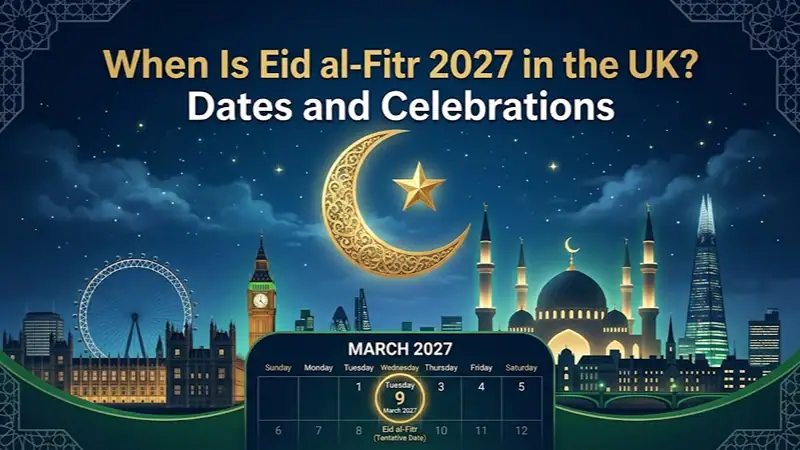
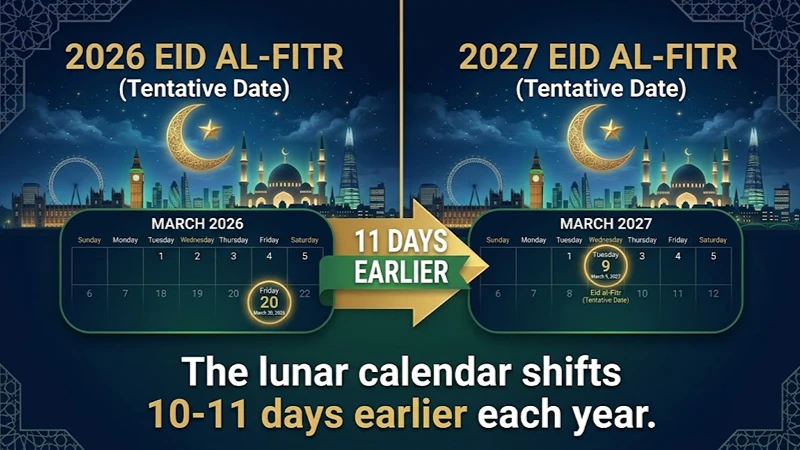
Friday 20 March 2026 was the day most UK Muslim communities marked Eid al Fitr. A few observed it twenty-four hours later, which came down to how their local moon sighting went. Looking ahead to 2027, Tuesday 9 March is the expected date, though nothing is fixed until the Shawwal crescent is confirmed. Eid closes Ramadan and opens the Islamic month of Shawwal.
Ramadan happens to be the busiest pilgrimage season there is. Travelling around it as well as Eid? Our Umrah packages from the UK set out what’s on offer and which dates tend to go first.
At a Glance: Eid al Fitr 2026 vs 2027
| Year | Eid al Fitr date | Day | Status |
|---|---|---|---|
| 2026 | Friday 20 March 2026 | Friday | Observed by many UK communities |
| 2027 | Tuesday 9 March 2027 | Tuesday | Expected date, subject to moon sighting |
Eleven days earlier. That’s the shift between 2026 and 2027, and there’s nothing odd about it. The Islamic calendar tracks the moon, while everything else in British life runs on the Gregorian one.
Booking leave? Sorting school activities, family travel or an Eid gathering? Work to Tuesday 9 March 2027, but leave yourself a day of wiggle room until your mosque confirms the sighting.
When Is Eid al Fitr 2027 in the UK?
Tuesday 9 March 2027 is the expected date across the UK.
Ramadan has to finish first. It’s the ninth month of the Islamic calendar and runs for either 29 or 30 days. Shawwal, the month after, only begins once someone confirms the new crescent moon after sunset.
Which is why that confirmation carries so much weight. Calendars predict Eid with impressive accuracy these days. They still can’t override whatever your mosque announces on the night.
So you’ll get some UK communities celebrating on Tuesday 9 March, and others holding off until Wednesday 10 March because their sighting method landed differently.
Most households end up refreshing a mosque website or WhatsApp group in those final Ramadan days. Obvious, yes. Easy to forget when you’ve got leave forms and flight bookings hanging over you.
What Date Was Eid al Fitr in 2026?
Friday 20 March 2026 was the day for most communities across the UK.
Everything hinged on Thursday evening. Moon sighting reports that night settled whether Eid would arrive the following morning.
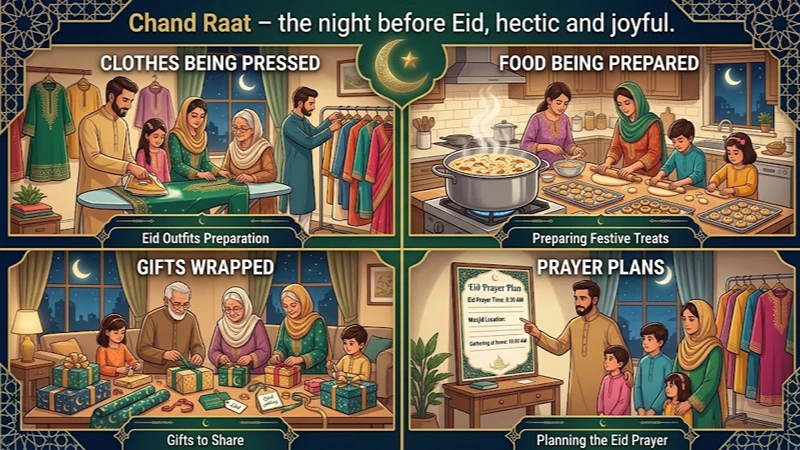
Plenty of South Asian families call that evening Chand Raat. It’s hectic and joyful in equal measure, with clothes being pressed, food prepared, gifts wrapped and prayer plans sorted well past midnight.
Timings weren’t identical everywhere. That’s normal, and it certainly doesn’t mean anyone got it wrong. Some mosques go with verified local sightings, others with reports from abroad, others with astronomical calculation, others again with a particular religious authority.
Coordinating work and family around a one day gap can be a headache. It’s also just how a lunar calendar behaves.
Why Does Eid al Fitr Change Date Every Year?
The Hijri calendar follows the moon, and that’s the whole explanation.
Roughly 365 days in a Gregorian year. Around 354 in an Islamic lunar one. That 10 or 11 day difference drags Ramadan and Eid al Fitr backwards through the year, every year, without fail.
Around 20 March in 2026. Around 9 March in 2027. Keep going and you’ll watch it travel through winter, autumn, summer, spring and back again.
Which explains something a lot of people notice over a lifetime: Ramadan isn’t always the same experience. Long British summer fasts one decade, short winter ones the next. The purpose doesn’t shift. How it feels absolutely does.
Why Can Eid Be Different Dates in Different UK Communities?
It all traces back to Shawwal, and Shawwal begins when the new crescent moon is sighted.
Several recognised methods are in use.
| Approach |
|---|
| Verified local moon sightings in the UK |
| National moon sighting announcements |
| Confirmed sightings from another country |
| Astronomical calculations of the new lunar month |
| A religious authority with an established calendar method |
Hence the situation where your cousin in Bradford celebrates on a different day to your colleague in Birmingham. London, Manchester and Glasgow mosques may all land somewhere slightly different too.
Where people trip up is treating a prediction as settled fact. Build your plans around the expected date, then hold a bit of slack for the actual announcement.
For anyone managing staff, running a school or organising an event, nobody should have to explain or defend which method they follow. Ask which day they’re expecting. Tell them what flexibility exists. Done.
What Does Eid al Fitr Mean?
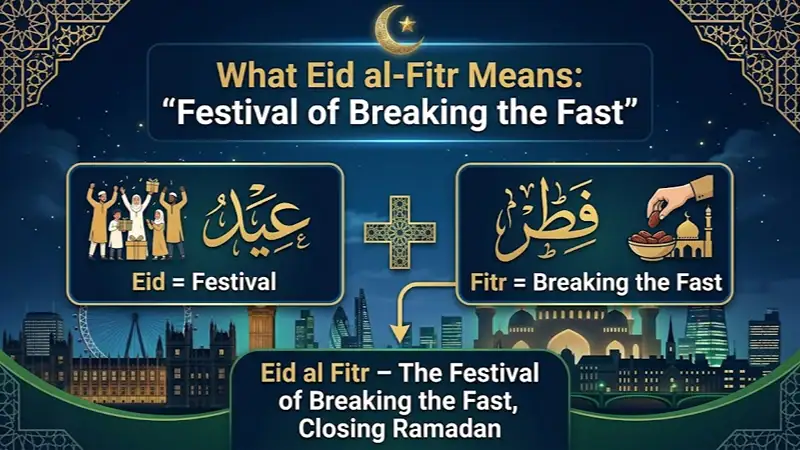
Translated, Eid al Fitr is the festival of breaking the fast. It closes Ramadan, the month of fasting from dawn until sunset alongside prayer, charity, patience and gratitude.
“Eid” is festival. “Fitr” points to breaking the fast. Nobody fasts on that first day. Instead there’s a special congregational prayer, then hours spent with family, neighbours and whoever else turns up.
Relief is a big part of it after a demanding month. But it isn’t only celebration. A month of pre dawn meals, late night prayers, charity collections and genuine effort to be better leaves a mark, and Eid is partly about carrying some of that forward.
Food matters. So do new clothes, gifts and the endless round of visits. None of that is really the point, though.
Zakat al Fitr and Giving Before Eid
Zakat al Fitr sits right at the heart of Eid. Some communities know it as Fitrana.
Eligible Muslims pay it before the Eid prayer. The reasoning is straightforward enough: people in need should be able to share in the day, with food on the table and basics covered.
Mosques handle most of it in the UK, though registered charities and humanitarian organisations take plenty too, usually in the closing days of Ramadan. The figure shifts year to year, normally tracking the cost of staple food or a set charity guideline.
Don’t leave it late. Zakat al Fitr should reach people before the Eid prayer, not afterwards, and chasing it on the morning itself is the kind of avoidable stress nobody needs when guests are arriving and prayers start at seven.
How Eid al Fitr Is Celebrated in the UK
British Eid doesn’t have a single template. Families here trace back to South Asia, the Middle East, North and East Africa, Turkey, Europe and plenty further afield. Food differs, language differs, customs differ.
Some threads run through nearly all of it, though.
Eid prayer
Early start. The congregational prayer might be at a mosque, an Islamic centre, a sports hall, a park or whatever venue can hold everyone.
Crowds are the issue, which is why plenty of mosques run two or three sessions. Get there early, take the bus or train if that’s realistic, and check the parking situation before setting off.
Sermons tend to circle back to Ramadan, gratitude, generosity, family ties and looking after people who are struggling.
Eid Mubarak greetings
“Eid Mubarak” is the greeting. It means “Blessed Eid”.
Prayer finishes and the hugging starts, along with handshakes and reunions with relatives nobody’s seen for months. Some families spend the entire day driving between houses. Others throw the doors open and let everyone come to them, which works better when relatives are scattered.
Food and family meals
Food is enormous on Eid, though what lands on the table depends entirely on the household.
Seviyan, biryani, kebabs, curries and sweets in a Pakistani British home. Rice dishes, fish and sweets in a Bangladeshi one. Arab families might do lamb, pastries, dates and coffee. Somali, Turkish, Nigerian, Afghan, Kurdish and Bosnian households each bring something different again.
Honestly, that variety is one of the best things about Eid here. Two gatherings in the same city can feel like two different celebrations entirely.
Gifts for children
Money, gifts, clothes, toys, sweets. Many families call it Eidi.
Amounts hardly matter. For a child it’s the build up that counts, and new clothes plus a house full of relatives plus a special breakfast plus cash from grandparents plus no school adds up to something huge.
Community events
Eid fairs, family days, food markets and public celebrations pop up wherever there’s a sizeable Muslim population. London, Birmingham, Manchester, Bradford, Leicester, Luton and Glasgow usually have something running.
Ticketed events exist alongside ones put on by mosques, charities, schools and local groups. Going along? Check the confirmed date and timing once the Eid announcement is made.
Is Eid al Fitr a Bank Holiday in the UK?
It isn’t. There’s no statutory bank holiday for Eid al Fitr anywhere in the UK.
No automatic day off, then. Employers do often help though, whether that’s annual leave, flexible hours, a shift swap, unpaid leave or a formal religious observance policy.
How much help varies wildly. Big organisations sometimes let staff trade a public holiday for a religious one. Smaller firms usually sort it informally over a conversation. Either way, get your request in early, particularly when Eid falls midweek.
Tuesday 9 March 2027 is midweek. Most people will be booking leave or negotiating something flexible.
One detail gets overlooked constantly: it’s the morning that matters. Someone might manage an afternoon shift perfectly well, but Eid prayer, family and travel all happen before lunch. Shifting someone’s start time by three hours beats any inclusion statement you could write.
Planning for Eid al Fitr 2027
Sorting rotas, school events, travel, catering or a community activity? Here’s the practical version.
| Step |
|---|
| Mark Tuesday 9 March 2027 as the expected Eid date |
| Keep Wednesday 10 March 2027 in mind as a possible alternative |
| Do not publish a final event date without saying it depends on the moon sighting |
| Ask your local mosque when they expect to announce the date |
| If you manage staff, ask early which date they expect to observe |
| If you are hosting an event, check prayer times, parking, capacity and food needs |
A bit of give in the plan saves a lot of grief later. It also stops you advertising an Eid offer on the wrong day for the community you’re trying to reach, which is a bad look and entirely avoidable.
Ramadan comes first, and that’s when a lot of UK families travel. Thinking about Ramadan Umrah packages? The last ten nights disappear first, so lock those dates in alongside your Eid plans rather than treating them as an afterthought. Aqdas Travel handles pilgrimage trips for Muslims right across the UK, Hajj packages included, and we’re ATOL protected under licence 12834.
Frequently Asked Questions
When is Eid al Fitr in 2027 in the UK?
Tuesday 9 March 2027 is what’s expected. Everything rests on the Shawwal crescent moon, so certain mosques and communities may end up observing it on Wednesday 10 March instead.
What date was Eid al Fitr in 2026?
Friday 20 March 2026 for most UK communities. The date came down to moon sighting confirmation as Ramadan closed, which is why it varied slightly depending on which method a community followed.
Why is Eid al Fitr earlier in 2027?
Because the Islamic calendar is lunar and runs roughly 10 or 11 days shorter than the Gregorian one. Ramadan and Eid therefore keep sliding earlier through the Gregorian year.
Can Eid be on different dates in different parts of the UK?
Yes, and it happens regularly. Mosques may rely on local sightings, national announcements, sightings reported from overseas or astronomical calculation. Two communities in the same city can easily land on different days.
Is Eid al Fitr a public holiday in the UK?
No, there’s no official UK bank holiday for it. You’ll likely need annual leave, a flexible shift, unpaid leave or some other arrangement through whatever policy your employer runs.
What is Zakat al Fitr?
A charitable payment eligible Muslims make ahead of the Eid prayer, intended to let people in need take part in the day. Most pay through a mosque, a charity or a community organisation.
What do people do on Eid al Fitr?
Attend Eid prayer, greet each other with “Eid Mubarak”, visit relatives, eat together, give children gifts and donate to charity. Beyond that, traditions differ enormously across UK Muslim communities.
So: Tuesday 9 March 2027 is the date to work towards, and Friday 20 March 2026 was the one most people marked last year. Plan around the expectation, wait for your mosque to confirm. That moon sighting isn’t a calendar formality for Muslims. It’s the start of Eid.