
Visiting Masjid Quba: Rewards, Timings and Practical Tips
Visiting Masjid Quba means doing wudu at your accommodation. Then travel three kilometres from Masjid an Nabawi. Pray two rak’ahs inside. The reward is described as being like that of an Umrah. The mosque is open around the clock, entry is free, and early morning or after Maghrib avoids both crowds and heat.
Most UK pilgrims fit Quba into their Madinah days, and every itinerary we build into our Umrah packages leaves room for it. Here is how to do the visit properly.
The reward, and what it actually requires
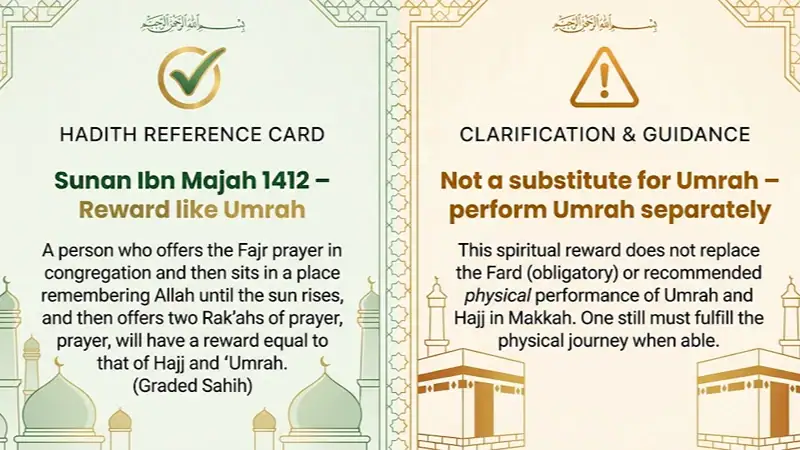
The narration is straightforward. Sahl ibn Hunayf reported that the Prophet ﷺ said whoever purifies himself in his house, then comes to the Quba Mosque and offers one prayer there, will have a reward like that for Umrah. It appears in Sunan Ibn Majah at hadith 1412, and is also recorded through Ahmad and al Nasa’i, classed as authentic.
Two things people get wrong here.
First, this isn’t a substitute for Umrah. It’s a reward “like” an Umrah, which is a different claim entirely. If you’ve come to Saudi Arabia intending Umrah, you still perform it.
Second, the phrase “in his house” causes genuine anxiety. Commentators have addressed it directly. Al Sindi explained that mentioning Quba was not the reason for the reward. It was to show the reward applies to those living nearby. They can purify themselves and pray with the same wudu. The people of Madinah and Quba could do this. The operative point is arriving in a state of purity from your place of stay. For a UK pilgrim, your hotel is your place of stay for that trip. Do wudu there, keep it, pray at Quba.
There’s honest scholarly discussion about how strictly to read the wording. If you break wudu on the way and renew it at the mosque, you’ve still prayed at Quba and the visit still counts for a great deal. Don’t let a technical worry stop you going.
Getting there from Masjid an Nabawi
| Option | Journey time | Approximate cost | Best for |
|---|---|---|---|
| Walking the Quba trail | Around 45 minutes for the 3 km route | Free | Following the Prophet’s ﷺ own practice |
| Madinah city bus | Around 15 minutes | SAR 3.45, roughly 70p | Budget travel, decent frequency |
| Electric buggy along the walkway | Around 5 minutes | About SAR 10, roughly £2 | Elderly parents, tired legs |
| Taxi or ride hailing | Around 10 minutes | Typically £4 to £6 | Groups, late night, bad weather |
| Hop on hop off bus | Varies by route | Day ticket pricing | Combining with Uhud and other ziyarat |
Fares shift with the exchange rate and the season, so treat these as planning figures rather than quotes.
The walk deserves its own mention. The Quba Walking Trail is a purpose built pedestrian corridor running roughly three kilometres from the southern gates of Masjid an Nabawi to Quba Square, and it follows the same historic path the Prophet ﷺ used on his visits. The boulevard is wide and palm shaded, with benches, evening lighting, shops and cafés along the way. Reckon on roughly 5,000 steps at a normal pace. After Fajr the trail is quiet and cool and you’ll mostly pass individual walkers. After Maghrib the lighting comes on and the cafés fill, so it becomes a slower, busier, more social walk. Same distance, completely different experience.
Timings and the crowd pattern
Madinah sources indicate the mosque is open 24 hours a day, seven days a week, with no ticketed time slot system and free entry.
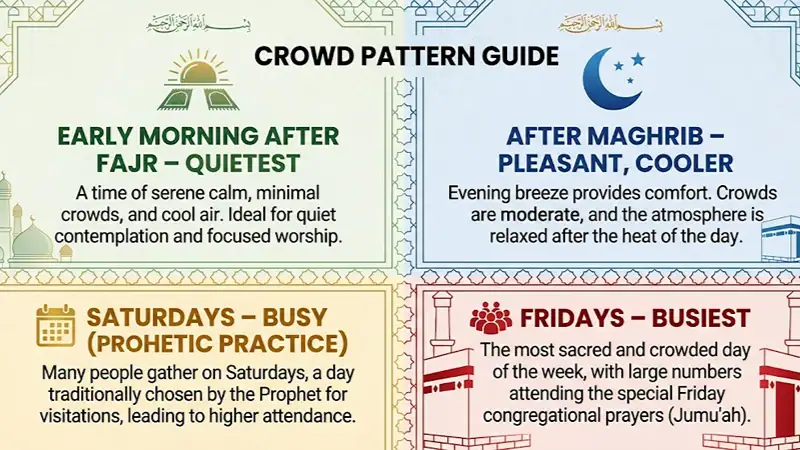
The crowd pattern is predictable once you know it. It’s narrated in Sahih Muslim that the Prophet ﷺ would go to Masjid Quba every Saturday, walking or riding. Many pilgrims follow that, so Saturdays are busy. Fridays are worse, because people pray at Quba before heading to Jumu’ah at the Prophet’s Mosque.
Early morning after Fajr is the quietest window and the most pleasant. After Maghrib works well too, when the glare drops off the white marble and the walkway fills with families rather than heat.
Budget your time properly. Twenty to thirty minutes covers a quick prayer and a look around, 45 to 60 minutes gives you a fuller visit, and 1.5 to 3 hours lets you take in Quba Square and part of the walking corridor. Add the travel time each way on top.
What usually goes wrong
People treat it as a photo stop. It’s an active mosque with thousands praying. Cover shoulders and legs, women should bring a head covering, men shouldn’t wear shorts, and everyone removes shoes before entering prayer areas. Keep phones down inside, especially during prayer times.
People go at midday. Madinah heat plus a three kilometre walk is a bad combination, particularly for older family members.
People assume the layout is fixed. A major expansion is under way aiming to increase the mosque’s size several times over, and that means paths around the mosque can shift during works. Approach routes and entrances change. Ask a member of staff rather than trusting an old blog photo.
People with limited mobility get caught out. Wheelchair accessible entry and parking are documented, but current official confirmation for internal lifts is harder to verify, so anyone needing step free access inside should check locally on arrival.
Women’s provision is good here. The women’s prayer area occupies the northern section across two floors, with capacity for several thousand worshippers.
Frequently asked questions
What is the reward for praying at Masjid Quba?
A reward described as being like that of an Umrah, for someone who purifies himself at his place of stay and then prays there. The narration is in Sunan Ibn Majah 1412 and is classed as authentic. Most pilgrims pray two rak’ahs, following the Prophet’s ﷺ practice, though the narration mentions one prayer.
How far is Masjid Quba from Masjid an Nabawi?
Roughly three kilometres to the south. The purpose built walking trail takes around 45 minutes at a steady pace, or you can travel by bus, taxi or electric buggy in ten to fifteen minutes. The trail begins near the southern gates of the Prophet’s Mosque and ends at Quba Square.
What are Masjid Quba’s timings?
Open 24 hours a day, seven days a week, with no booking system. Access to prayer areas is naturally restricted around congregational prayers for those not praying. Early morning and after Maghrib are the calmest periods. Saturdays and Fridays draw noticeably larger crowds than other days.
Do you have to do wudu at home to get the reward?
Commentators explain the wording as pointing to arriving already in a state of purity from your place of stay, rather than requiring a literal house. For a visiting pilgrim, that means your hotel. Perform wudu there and maintain it on the journey. If you need to renew it at the mosque, your prayer at Quba still stands.
Is there an entry fee for Quba Mosque?
No. Entry is free and no ticket or booking is required. Any charge you encounter relates to transport, a guided tour, or parking, never mosque admission itself. Be cautious of anyone selling “access” to the mosque, since no such product exists.
What is the best time to visit Masjid Quba?
Early morning after Fajr for quiet and cool air, or after Maghrib when the heat drops and the walkway lights up. Avoid midday, avoid Fridays if you dislike crowds, and expect Saturdays to be busy because of the prophetic practice of visiting that day.
Can women pray at Masjid Quba?
Yes. The women’s prayer area sits in the northern section of the mosque across two floors, with separate entrances and washroom facilities provided. The same modest dress expectations apply as at Masjid an Nabawi.
What to do next
Check the hadith yourself on sunnah.com at Ibn Majah 1412 rather than relying on paraphrases. Slot Quba into your Madinah itinerary on a morning other than Friday if you can, and tell your operator in advance if anyone in your group needs mobility support. Before you fly, read the FCDO’s Saudi Arabia travel advice on GOV.UK for current entry and health requirements, since those change more often than anything about the mosque does. If you want the trip arranged end to end, Aqdas Travel can handle the flights, hotels and ground transport.
One limitation worth stating: no UK government or academic body documents conditions at Madinah sites, so the practical details here draw on Saudi municipal sources and recent visitor reporting. Transport fares and access routes change, particularly with the expansion under way. Verify on the ground and treat this as preparation rather than the final word.