Umrah duas are fewer than most lists suggest. The fixed ones are the Talbiyah after your niyyah, a takbir at the Black Stone, Rabbana atina between the Yemeni corner and the Black Stone, and the remembrance on Safa and Marwah. Everything else, including each round of Tawaf, is your own dua in any language.
Below you’ll find every one of them in the order you’ll need it, with the Arabic, a transliteration you can read out loud and the meaning. We’ve also added where each one comes from. That column is there for a reason. Plenty of duas for Umrah shared on WhatsApp and in printed booklets have no traceable origin, and pilgrims end up worrying about wording that was never asked of them.
Umrah duas in order: quick reference
| Where you are | What to say | Source |
|---|---|---|
| Making your niyyah in ihram | Labbayk Allahumma ‘umrah | Based on Sahih Muslim 1251 |
| From the niyyah until Tawaf starts | The Talbiyah, as often as you can | Sahih al Bukhari 1549 |
| Entering Masjid al Haram | Salam on the Prophet ﷺ, then Allahummaftah li abwaba rahmatik | Sunan Abi Dawud 465, Sahih Muslim 713 |
| First sight of the Kaaba | Your own dua | No authentic fixed wording |
| Black Stone, start of each round | Bismillahi wallahu akbar | Sahih al Bukhari 1613 (takbir); Bismillah from Ibn Umar |
| Yemeni corner to Black Stone | Rabbana atina fid dunya hasanah… | Sunan Abi Dawud 1892 |
| The rest of Tawaf | Dhikr, Quran or your own dua | No fixed dua |
| Maqam Ibrahim | Wattakhidhu min maqami Ibrahima musalla, then two rakats | Sahih Muslim 1218 |
| Drinking Zamzam | Your own dua | Sunan Ibn Majah 3062 |
| Climbing Safa the first time | Innas safa wal marwata… Abda’u bima bada’allahu bih | Sahih Muslim 1218 |
| On Safa and Marwah each time | Takbir and tahlil three times, with dua in between | Sahih Muslim 1218 |
| Between the green lights | Rabbighfir warham… | Reported from Ibn Mas’ud (Musannaf Ibn Abi Shaybah) |
| Cutting your hair | No fixed dua | None |
| Leaving the mosque | Allahumma inni as’aluka min fadlik | Sahih Muslim 713 |
Screenshot this table or print it. Phones die quickly in the Makkah heat, and you won’t want to be scrolling during Tawaf.
Niyyah and the Talbiyah
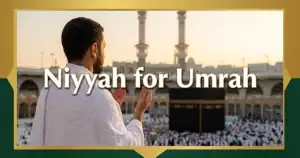
The niyyah is in your heart. The words you say when you enter ihram are short:
لَبَّيْكَ اللَّهُمَّ عُمْرَةً
Labbayk Allahumma ‘umrah.
Here I am, O Allah, for Umrah.
If you’re worried something might stop you finishing, such as an illness, an elderly parent’s health or a problem with your travel, you can add a condition. The Prophet ﷺ told Duba’a bint al Zubayr to say this (Sahih al Bukhari 5089):
اللَّهُمَّ مَحِلِّي حَيْثُ حَبَسْتَنِي
Allahumma mahilli haythu habastani.
O Allah, I will leave ihram wherever You hold me back.
Why bother? If you’re genuinely prevented, most scholars say this condition lets you come out of ihram without a penalty. Scholars do differ on whether it’s for everyone or only for people with a real reason to worry, so ask your own scholar if you’re unsure.
On direct flights from the UK to Jeddah you’ll cross the miqat in the air. Most airlines announce it, but don’t rely on the announcement alone. Ask the crew roughly when it’ll be, have your ihram on before you board or change at the airport, and make the niyyah a little early if you’re not sure. If you’re flying into Madinah first, you don’t need ihram on the plane. You’ll put it on at Dhul Hulayfah (Abyar Ali) on the drive to Makkah. We’ve written more on how to make the niyyah for Umrah if you want the detail.
Straight after the niyyah, start the Talbiyah:
لَبَّيْكَ اللَّهُمَّ لَبَّيْكَ، لَبَّيْكَ لَا شَرِيكَ لَكَ لَبَّيْكَ، إِنَّ الْحَمْدَ وَالنِّعْمَةَ لَكَ وَالْمُلْكَ، لَا شَرِيكَ لَكَ
Labbayk Allahumma labbayk, labbayka la sharika laka labbayk. Innal hamda wan ni’mata laka wal mulk, la sharika lak.
Here I am, O Allah, here I am. Here I am, You have no partner, here I am. All praise, all blessings and all sovereignty are Yours. You have no partner.
Men say it aloud. Most scholars say women should say it quietly enough for the person beside them to hear. You keep repeating it on the plane, in the coach and in the hotel lobby, and you stop when you begin Tawaf.
Entering Masjid al Haram and seeing the Kaaba
Step in with your right foot, send peace and blessings on the Prophet ﷺ in any words you know, and then say (Sunan Abi Dawud 465, Sahih Muslim 713):
اللَّهُمَّ افْتَحْ لِي أَبْوَابَ رَحْمَتِكَ
Allahummaftah li abwaba rahmatik.
O Allah, open the doors of Your mercy for me.
Many people start with Bismillah, wassalamu ‘ala rasulillah. That’s fine to say, but the narration with those exact words (Sunan Ibn Majah 771) is graded weak, so treat it as optional.
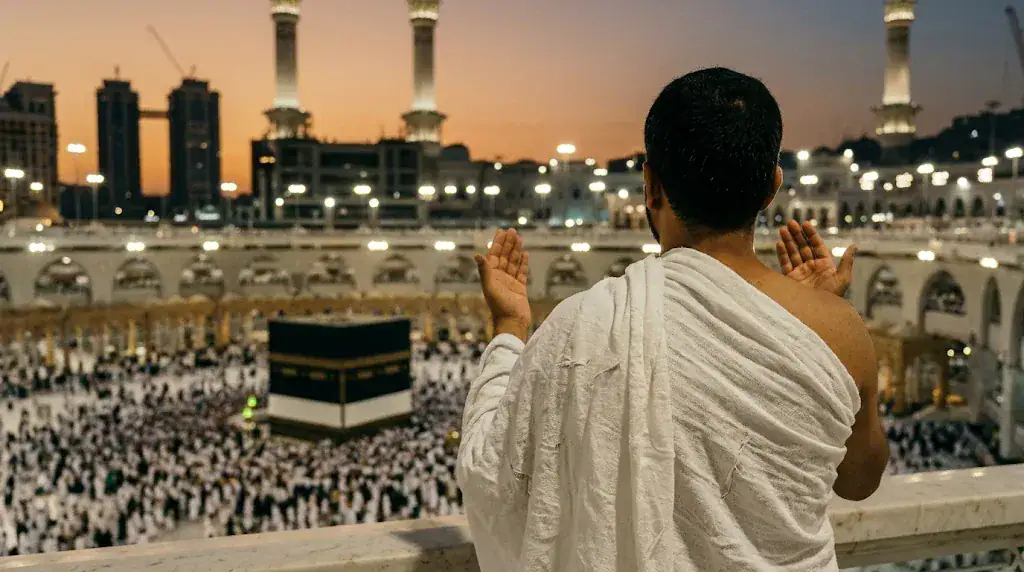
When you first see the Kaaba, you’ll find booklets that give a set dua, usually starting Allahumma zid hadhal bayta tashrifan. The narrations behind it are weak. Some scholars still allow it, and there’s no harm in saying it, but it isn’t required. Most people simply stop, raise their hands and ask for what matters to them.
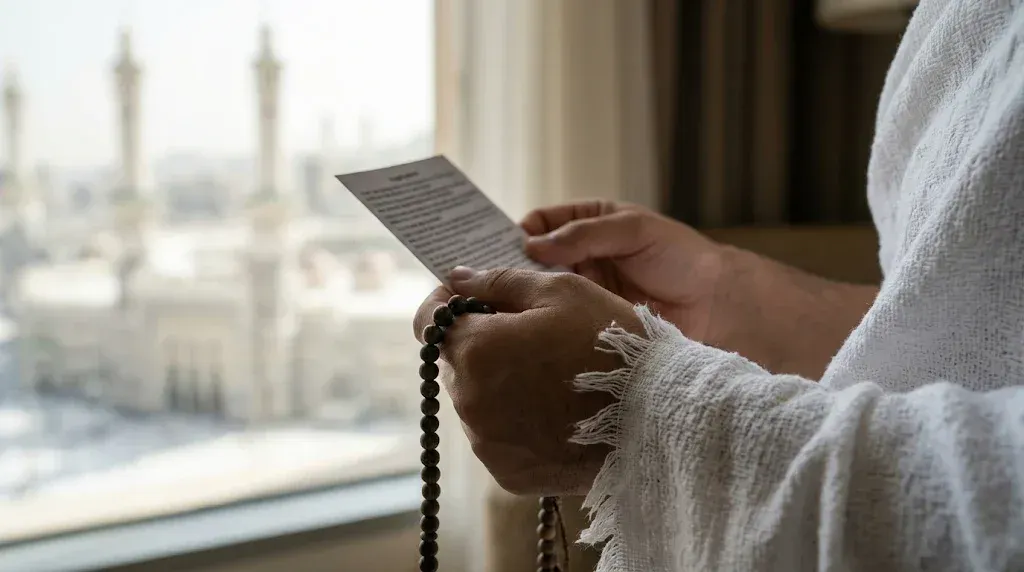
Many first timers go blank at that moment and only remember afterwards what they meant to ask for. So write your list before you leave home: your own needs, and the names of everyone who said “make dua for me”. Keep it on your phone or on the back of your dua card, and read through it slowly while you stand there.
Duas for Tawaf
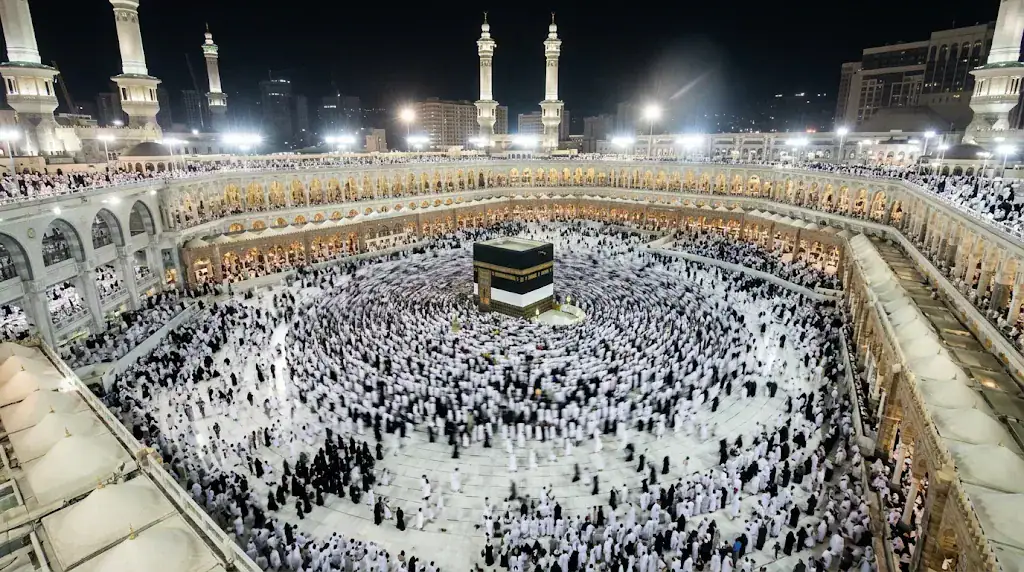
At the start of each round, face the Black Stone, point your right hand towards it and say:
بِسْمِ اللَّهِ، وَاللَّهُ أَكْبَرُ
Bismillahi wallahu akbar.
In the name of Allah, and Allah is the Greatest.
The takbir is in Sahih al Bukhari 1613. Ibn Umar used to say Bismillah with it, and many pilgrims do the same.
Between the Yemeni corner and the Black Stone, recite this verse (Quran 2:201):
رَبَّنَا آتِنَا فِي الدُّنْيَا حَسَنَةً وَفِي الْآخِرَةِ حَسَنَةً وَقِنَا عَذَابَ النَّارِ
Rabbana atina fid dunya hasanatan wa fil akhirati hasanatan wa qina ‘adhaban nar.
Our Lord, give us good in this world and good in the Hereafter, and protect us from the punishment of the Fire.
That’s it. For the rest of each round, there’s no fixed dua. The popular “dua for round one, dua for round two” booklets were put together by later writers as a help. The words in them are mostly fine. The problem is what happens in practice: people read a page they don’t understand, sometimes in a loud chorus behind a group leader, and miss the chance to ask for what they actually need. A dua you understand and mean, in English or Urdu, is completely valid, and for most people it’s far easier to focus on.
When you finish, go towards Maqam Ibrahim and recite (Quran 2:125):
وَاتَّخِذُوا مِنْ مَقَامِ إِبْرَاهِيمَ مُصَلًّى
Wattakhidhu min maqami Ibrahima musalla.
And take the standing place of Ibrahim as a place of prayer.
Pray two short rakats behind it if there’s room, or anywhere in the mosque if there isn’t. The Prophet ﷺ recited Surah al Kafirun and Surah al Ikhlas in these two rakats (Sahih Muslim 1218). Then drink Zamzam. The Prophet ﷺ said Zamzam is for whatever it’s drunk for, so make your own dua while you drink.
Duas for Sa’i at Safa and Marwah
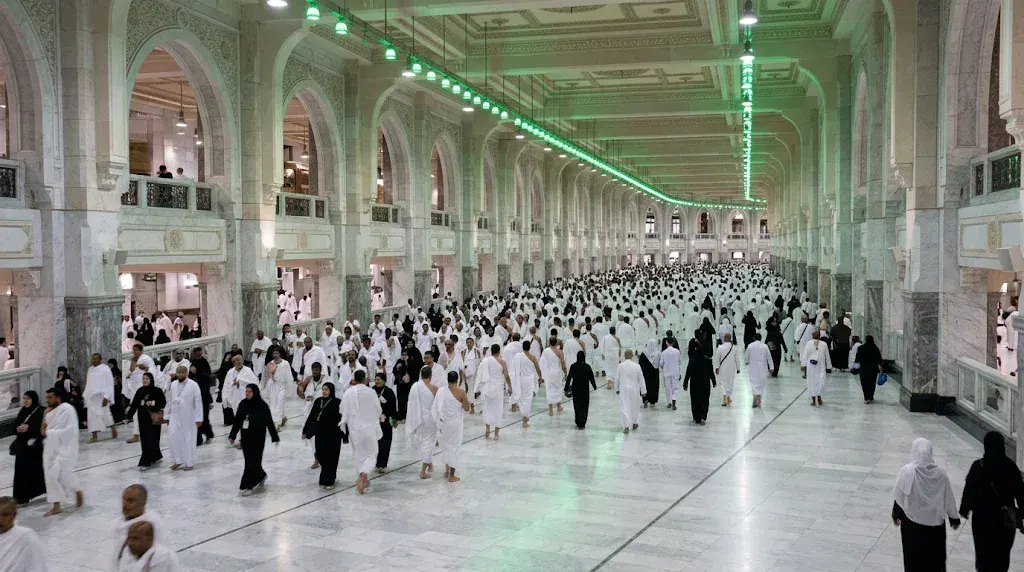
As you approach Safa for the first time, recite this verse:
إِنَّ الصَّفَا وَالْمَرْوَةَ مِنْ شَعَائِرِ اللَّهِ
أَبْدَأُ بِمَا بَدَأَ اللَّهُ بِهِ
Innas safa wal marwata min sha’a’irillah.
Safa and Marwah are among the symbols of Allah. (Quran 2:158)
After the verse, say what the Prophet ﷺ said next (Sahih Muslim 1218): Abda’u bima bada’allahu bih.
I begin with what Allah began with.
You only say this once, at the start. Then climb until you can see the Kaaba, face it, raise your hands, say Allahu akbar, and then:
لَا إِلَٰهَ إِلَّا اللَّهُ وَحْدَهُ لَا شَرِيكَ لَهُ، لَهُ الْمُلْكُ وَلَهُ الْحَمْدُ، وَهُوَ عَلَى كُلِّ شَيْءٍ قَدِيرٌ. لَا إِلَٰهَ إِلَّا اللَّهُ وَحْدَهُ، أَنْجَزَ وَعْدَهُ، وَنَصَرَ عَبْدَهُ، وَهَزَمَ الْأَحْزَابَ وَحْدَهُ
La ilaha illallahu wahdahu la sharika lah, lahul mulku wa lahul hamd, wa huwa ‘ala kulli shay’in qadir. La ilaha illallahu wahdah, anjaza wa’dah, wa nasara ‘abdah, wa hazamal ahzaba wahdah.
There is no god but Allah alone, with no partner. His is the dominion and His is the praise, and He has power over all things. There is no god but Allah alone. He kept His promise, helped His servant and defeated the confederates alone.
Say it three times and make your own dua in between. Do the same each time you reach Safa or Marwah, without the verse.
Between the green lights, men walk faster. Many pilgrims say this here, a dua reported from the Companion Ibn Mas’ud:
رَبِّ اغْفِرْ وَارْحَمْ، إِنَّكَ أَنْتَ الْأَعَزُّ الْأَكْرَمُ
Rabbighfir warham, innaka antal a’azzul akram.
My Lord, forgive and have mercy. You are the Most Mighty, the Most Generous.
Seven lengths in total. You start at Safa and finish at Marwah.
Cutting your hair, and leaving the mosque
There’s no fixed dua for cutting your hair. Some lists give one that begins hadhihi nasiyati, but we couldn’t find it in the major hadith collections. Thank Allah in your own words. Men shave the whole head or shorten the hair all over. Women cut about a fingertip’s length from the ends. Once that’s done, your Umrah is complete and the ihram restrictions end.
Leave the mosque with your left foot and say:
اللَّهُمَّ إِنِّي أَسْأَلُكَ مِنْ فَضْلِكَ
Allahumma inni as’aluka min fadlik.
O Allah, I ask You of Your bounty.
What usually goes wrong
The most common mistake has nothing to do with pronunciation. People spend the whole Tawaf looking down at a booklet. Learn the two short Tawaf duas before you fly and you’ll have your hands and head free.
People also stop the Talbiyah too early, often when they check into the hotel, or carry on saying it during Tawaf. It runs from the niyyah until Tawaf begins.
Women on their period can still say the Talbiyah and every dua here. They can’t do Tawaf until they’re clean, and Sa’i comes after Tawaf, so it waits as well. If your dates are tight, plan for this before you book.
Finally, heat. The Foreign Office’s pilgrimage advice for Saudi Arabia warns that summer temperatures can pass 50°C. In those months, an Umrah done after Isha is far easier to concentrate on than one at midday.
Frequently asked questions
Which duas should I recite during Umrah?
Learn the Talbiyah, Bismillahi wallahu akbar at the Black Stone, Rabbana atina between the Yemeni corner and the Black Stone, and the takbir and tahlil on Safa and Marwah. Those are the duas tied to fixed points in the Sunnah. Everything else is open, so prepare a short personal list for yourself, your family and anyone who asked you to pray for them.
What is the first dua to read during Tawaf?
At the Black Stone, at the start of the first round, say Bismillahi wallahu akbar while pointing your right hand towards it. You repeat this at the start of every round. Before that, you should already have stopped the Talbiyah, because it ends as Tawaf begins. There’s no separate opening dua beyond this.
What dua do you recite at Safa and Marwah?
On reaching Safa the first time, recite Innas safa wal marwata min sha’a’irillah and say Abda’u bima bada’allahu bih. Then face the Kaaba, say Allahu akbar, and follow it with La ilaha illallahu wahdahu la sharika lah and the rest of the remembrance. Repeat it three times with your own dua between. Do the same on Marwah, without the verse.
How do you do Umrah step by step with dua?
Enter ihram at or before the miqat with the niyyah and Talbiyah, do Tawaf with the Black Stone takbir and Rabbana atina, pray two rakats at Maqam Ibrahim, drink Zamzam, do Sa’i with the Safa and Marwah remembrance, then shave or trim your hair. The table at the top of this page follows that order exactly.
Is there a different dua for each round of Tawaf?
No. The Prophet ﷺ didn’t teach a separate dua for each of the seven rounds. The round by round duas in many booklets were written later as a help, and reading them isn’t wrong. But they aren’t required, and a sincere dua in your own language is just as valid. Use whatever helps you concentrate.
Before you fly
Print the reference table and keep it in your ihram belt. Learn the Talbiyah and Rabbana atina by heart; they’re the two you’ll use most. Write your personal dua list now, while you’re calm at home, not in the crowd at the Kaaba. Download the official Nusuk app before you travel. And check the TravelHealthPro Hajj and Umrah factsheet for the ACWY meningitis vaccine, which you need at least 10 days before you arrive.
If you’d like every ritual explained in full, read our step by step Umrah guide. And if you’re still choosing dates and hotels, you can compare our Umrah packages from the UK.