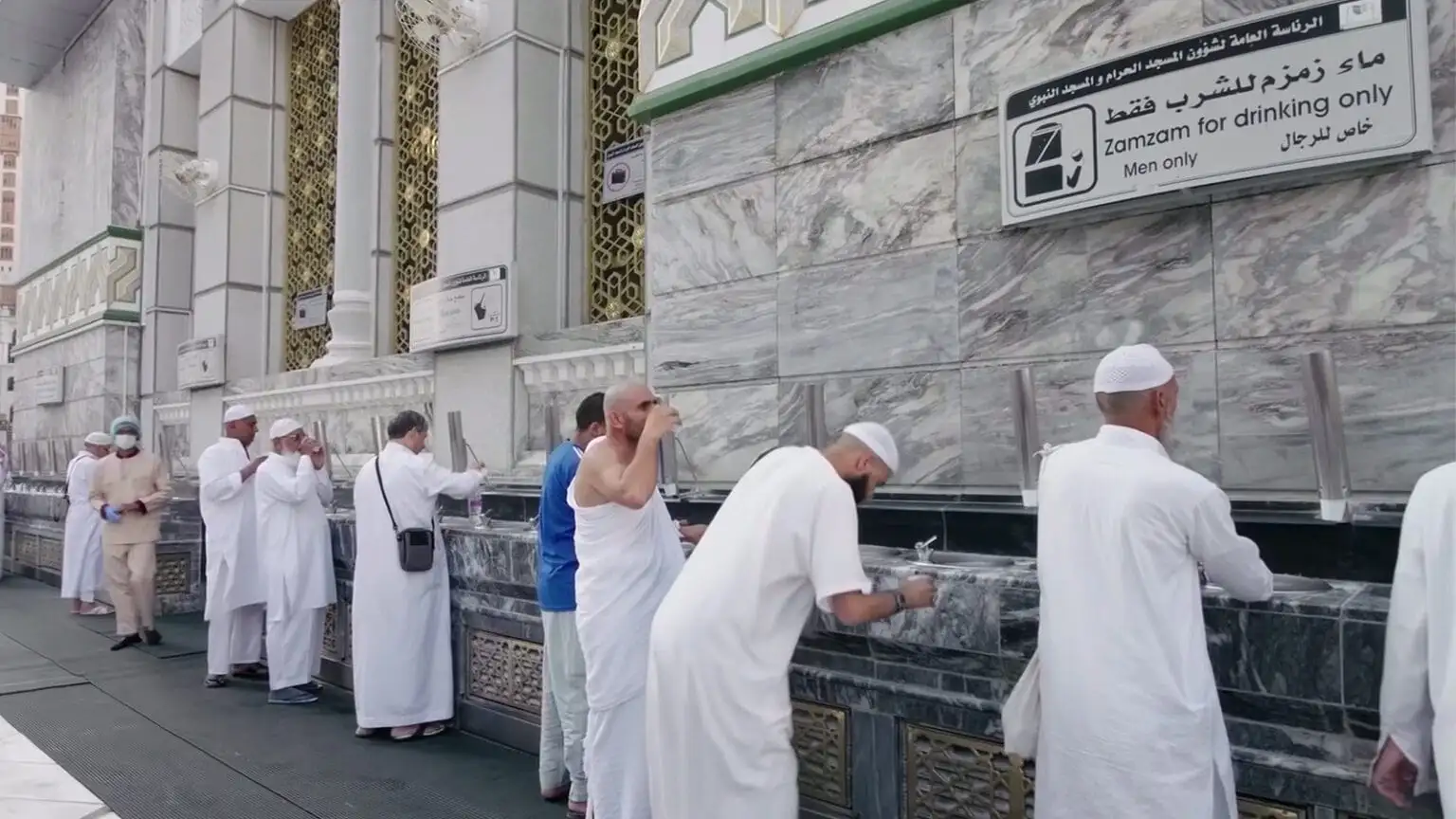
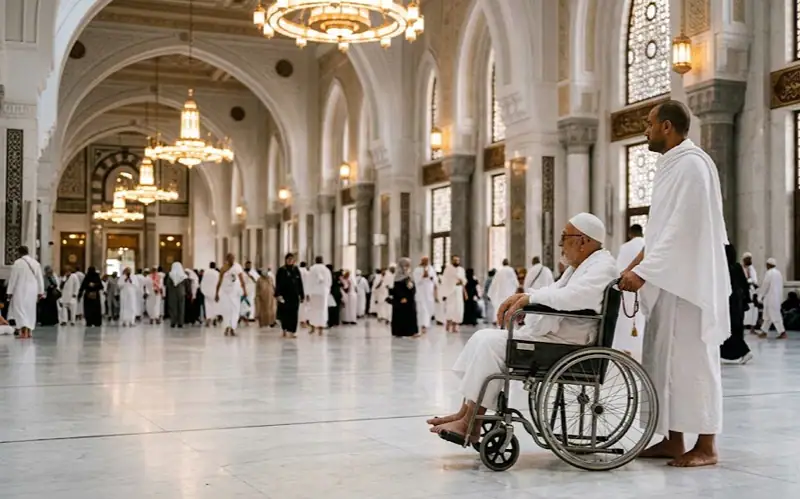
Tawaf and sai in a wheelchair are valid. If walking is genuinely difficult or harmful, you may complete all seven circuits of the Kaaba and all seven passages between Safa and Marwah seated, whether pushed by a family member, pushed by a hired assistant, or riding an electric cart. Where the need is genuine, no penalty applies and no extra rite is owed.
That’s the ruling settled. The harder part is choosing the right service, at the right gate, on the right floor, without paying three times the going rate. If you’re still comparing Umrah packages, mobility support is worth settling before you book, not after.
Which mobility option fits your pilgrim
Most guides list every service. That doesn’t help. Match the option to the person instead.
| Option | Best for | Where to get it | Typical published rate | The catch |
|---|---|---|---|---|
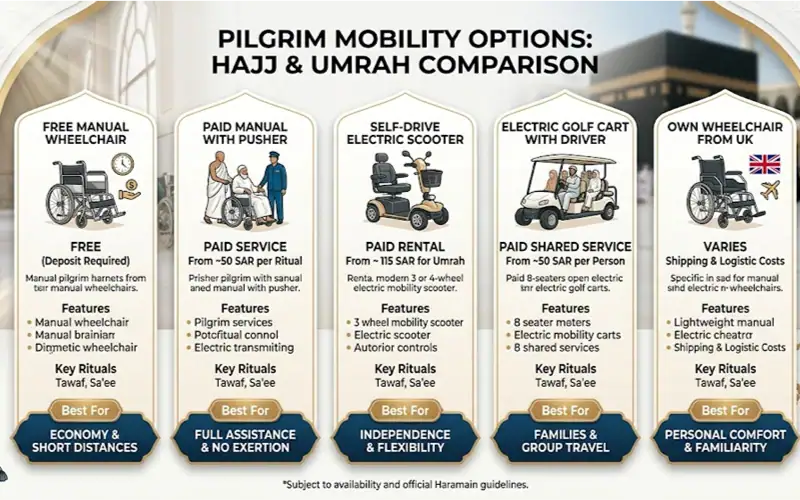
| Free manual wheelchair | Pilgrims travelling with a fit family member who can push | Gates of Masjid al Haram including King Abdul Aziz Gate, Gate 74 and Ajyad Gate, first come first served | Free (ID often held as deposit) | Runs out fast at peak times. The Council of British Hajjis notes that carrying documentation such as a UK Blue Badge can secure free use of mobility aids that would otherwise be charged |
| Paid manual wheelchair with a pusher | No able companion, but the pilgrim wants ground level proximity | Official paid points, or informal pushers at the gates | Roughly SAR 100 to SAR 300 (about £20 to £60) reported by pilgrims | Informal pricing is negotiated, not fixed. Agree the total and the finish point before you start |
| Self drive electric scooter | Independent pilgrims with upper body strength | Booked through the Tanaqol app, operating on the third floor, which is an electric vehicle only zone | From SAR 57.50 single seater for tawaf or sai, SAR 115 for both (about £12 and £23) | Book at least a day ahead in peak season |
| Electric golf cart with driver | Frail or elderly pilgrims who cannot self propel | Managed through the Tanaqol app, with roughly 5,000 carts across the mosque | Widely quoted at 300 SAR for a full Umrah, with complimentary service for verified disability | Rates published by different services conflict. Verify in the app on the day |
| Your own wheelchair from the UK | Long stays, or a pilgrim with a custom seating need | Bring it as assistive equipment. The CAA allows up to two mobility items free of charge | No charge on flights from the UK | Marble ramps and lifts are fine, but wide chairs struggle in crowd funnels. Powered chairs need battery details declared to the airline in advance |
Be honest about that price column. Rates quoted publicly in early 2026 range from SAR 50 to SAR 300 for what sounds like the same service, because tawaf only, sai only, full Umrah and full day hire all get described loosely as “a wheelchair”. Check the Tanaqol app for the official figure and treat anything quoted verbally at a gate as a starting offer.
Which floor you’ll actually use
This is where families get separated. The ground floor Mataf has allocated slower paced paths that include wheelchair users, while the third floor carries a dedicated circular track for electric carts where the route is far less congested. A manual chair pushed by a relative can usually stay on the ground floor at quiet hours. During Ramadan, Fridays and the hours between Maghrib and Isha, expect to be redirected upstairs.
The distance upstairs is longer. That’s the trade. But the pace is steady and nobody is pressing against the chair, which matters more for a nervous eighty year old than saving ten minutes. Tawaf on an upper floor is sound, and the Permanent Committee for Islamic Research and Fatwa ruled it correct in the context of severe overcrowding.
For sai, the Mas’a has a marked central lane. The middle strip is now largely given over to electric chairs, so a manual chair with a pusher generally travels in the walking lanes at the side.
The two ruling questions families always ask
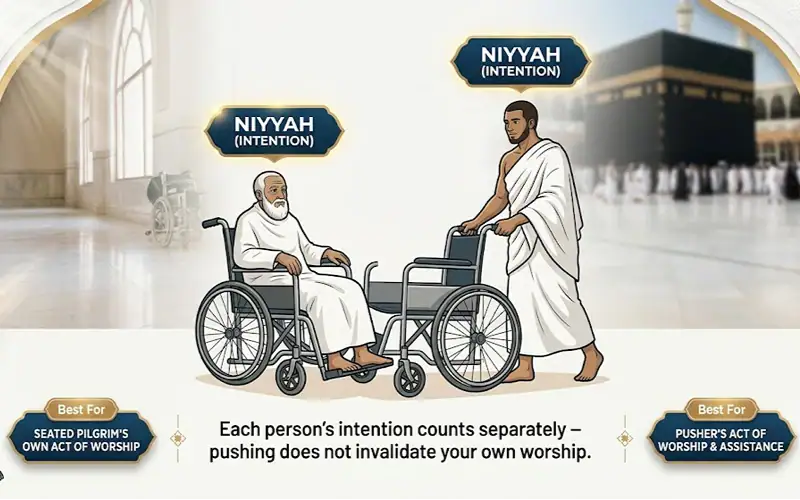
Does the pusher’s tawaf count as their own?
Yes, provided each person makes their own intention. Pushing a relative’s wheelchair does not affect the validity of your own worship, because each of you holds a separate intention and performs tawaf and sai for yourself. You do not need to repeat it afterwards.
Is riding permitted when the need is borderline?
Here genuine debate exists, and honest guides should say so. Several scholars have held that sai performed while riding is not valid without an excuse, and Shaykh Ibn Uthaymeen advised walking sai for anyone who is able. The practical reading: if your parent can walk 200 metres but not 3 kilometres, use the chair without anxiety. If they can walk the whole distance comfortably and are simply avoiding the crowds, walking is the safer choice.
What usually goes wrong
The failures are almost never spiritual. They’re logistical.
Ihram is the first one. A seated pilgrim’s upper sheet slips constantly, and a male pilgrim must keep his head uncovered. Practise the wrap sitting down at home. Second, hydration. A pushed pilgrim doesn’t feel exertion the way a walker does, so they drink less and overheat faster, especially in a July or August departure.
Third, the finish point. Hired pushers routinely stop at Marwah and vanish, leaving an elderly pilgrim seated 400 metres from a lift they cannot reach. Agree the drop off gate in advance.
Fourth, medication. Some medicines prescribed in the UK are controlled substances in Saudi Arabia, UK prescriptions are not accepted there, and you may need an official prescription or a GP letter to bring them in.
Before you fly, agree three things with whoever is pushing: the gate you start at, the gate you finish at, and where you meet if you’re separated mid tawaf. Write them down. Phone signal inside the Mataf is unreliable.
Before you leave the UK
Book special assistance for the flight early. The Civil Aviation Authority advises requesting assistance when you book, or at minimum 48 hours before departure, through your airline, travel agent or tour operator, and keeping written confirmation. Read the CAA guidance on arranging special assistance before you ring the airline, because the phrasing you use determines whether you’re met at the aircraft door or the terminal entrance.
On health, pilgrims should seek pre travel advice ideally four to six weeks before departure. The NaTHNaC Hajj and Umrah factsheet is the reference UK travel clinics use. A valid MenACWY certificate is required, dated at least 10 days before arrival, and how far back it can be dated depends on which type of MenACWY vaccine you had, so check the date on your record rather than assuming. The FCDO pilgrimage advice for Saudi Arabia is worth rereading a fortnight before you fly. Get that letter at the same appointment as your vaccinations.
Insurance is the step families skip. A declared heart condition, a recent joint replacement or ongoing treatment will often be loaded or excluded by a mainstream policy. If an insurer declines your parent or quotes a heavy medical premium, they are required to point you towards a specialist directory, and the MoneyHelper travel insurance directory lists FCA regulated firms that cover more serious conditions. Start there rather than on a comparison site. Treat cold callers offering pilgrimage deals with suspicion, because the FCDO warns that organised crime groups in the UK target people booking Hajj and Umrah, with many victims over 65. Check any operator’s ATOL number on the CAA register before money changes hands.
Entry permits for the Haram, and the Rawdah slot in Madinah, are both handled in the Nusuk app. Wheelchair users are generally directed through designated gates at the Rawdah, and telling the volunteers on arrival helps. Book that slot the moment your travel documents are issued.
Frequently asked questions
Is tawaf valid in a wheelchair?
Yes. Seven circuits with the Kaaba on your left, made with intention and in a state of wudu, are valid whether you walk or are wheeled. Being propelled by another person is permitted where there’s a genuine need. No fidyah or compensation is owed for choosing the safer method.
Does the person pushing the wheelchair need to do their own tawaf?
No, as long as they make their own intention at the start. Each person’s tawaf and sai counts for themselves, and pushing a relative does not invalidate your own worship. Some pilgrims still repeat it unnecessarily. You don’t have to.
Can you perform sai in a wheelchair?
Yes, with a valid reason. A minority view holds that sai while riding is not valid absent an excuse, so anyone genuinely able to walk should walk. Age, cardiac conditions, joint replacement, respiratory difficulty and post surgical recovery all count as clear reasons.
Are wheelchairs free at Masjid al Haram?
Manual chairs are available free at several gates. The General Authority for the Care of the Two Holy Mosques provides them at points including King Abdul Aziz Gate, Gate 74 and Ajyad Gate, without prior booking. Supply runs short at peak hours, so go off peak if you can.
How much does an electric scooter cost for tawaf?
Through the Tanaqol app, a single seater is around SAR 57.50 for tawaf only or sai only, and SAR 115 for both, with double seaters at twice the rate. That’s roughly £12 and £23. Other cart services publish different figures, so confirm in the app.
Which floor do wheelchair users perform tawaf on?
Tawaf and sai in a wheelchair happen either on the ground floor slower paced lanes or on the upper levels. The third floor is reserved for electric vehicles only, with no manual chairs or walking traffic. Crowd marshals make the call on the night, so plan for both.
Can I bring my own wheelchair for Umrah?
Yes. The CAA allows up to two mobility items to travel free of charge, on top of your baggage allowance, and the Haram’s ramps and lifts accommodate personal chairs. If it’s a powered chair or scooter, give the airline the make, weight and full battery details when you book, or it may not be accepted. Bring a puncture repair kit and a spare cushion. Narrow folding frames handle the crowd funnels far better than wide powered chairs.
Where to go from here
Download Nusuk and Tanaqol before you fly and register both against your travel documents, because signing up on hotel wifi at 2am is nobody’s idea of ibadah. Ring your airline’s special assistance line rather than using the web form, and get the reference in writing. Book your GP or travel clinic appointment six weeks out and ask for the medication letter in the same visit.
Then pick your hotel on walking distance, not star rating. For a wheelchair user, 200 metres of level marble beats a marble lobby every time.
Limitations worth stating: cart pricing, gate allocations and floor access rules in Makkah change with the season and with crowd management decisions taken on the day. Everything above reflects officially published information at the time of writing. Verify in the Tanaqol app and with your operator before you travel.