Umrah Health Requirements UK
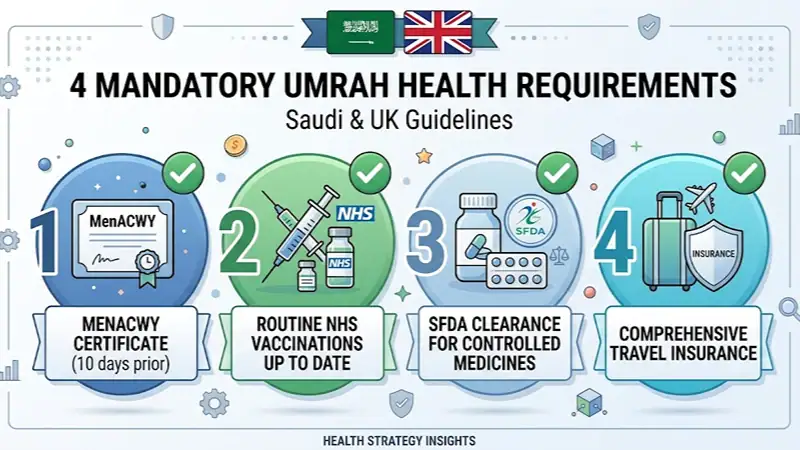
The simplified Umrah health conditions UK travelers must satisfy are as follows. You must have a MenACWY meningitis certificate that is dated not less than 10 days prior to landing, routine NHS vaccinations up to date and advance Saudi clearance for any controlled medicine you carry along with an insurance package more complete than the one linked to your entry permit.
Everything else is comfort. The other four are the ones that either halt your journey at an app desk or a customs counter.
Health History for Umrah: starting from departure and working backward
The problems that people complain about are usually not medical. They’re timing problems. This is the trick that will actually work for you.
| When | What you do | Why it matters | Typical UK cost |
|---|---|---|---|
| 8 weeks out | Book GP travel appointment or private clinic | GP travel appointments are frequently booked weeks in advance, and some surgeries do not offer travel at all | Free at GP where offered |
| 6 to 8 weeks out | If you use a controlled medication, apply for SFDA clearance | Approvals are not instantaneous and authorities can demand additional documents | Free to apply |
| 4 to 6 weeks out | MenACWY vaccine plus stamped certificate | Important at the stage of Nusuk application, not only at the airport | Around £35 to £60 privately |
| 4 weeks out | MMR, Diphtheria, Tetanus, Polio and flu status | Crowds Make Anything You’re Not Covered For Noisy | Usually free at GP |
| 2 to 3 weeks out | Purchase insurance exceeding the permit limit, schedule a dental exam | Toothache in Makkah spoiled what was supposed to be a short trip | Varies |
| Departure week | Original boxes, one box of each medicine with copy of prescription | Pill organiser with loose blister strips raises eyebrows | Free |
| First 14 days home | Be on the lookout for fever, severe headache, stiff neck, rash | Meningococcal disease can progress in hours | Free |
This is not a medical problem. It is a very common paperwork issue. It is about what to do with the mandatory certificate
The quadrivalent meningococcal ACWY vaccine is a vaccination entry requirement for Hajj and Umrah pilgrims, and as GOV.UK clearly states you will need to be in possession of valid proof at least 10 days before travelling. It’s that 10 day window that people misinterpret, because it counts back from the point of landing (the start of your holiday) rather than booking.
It is in the realm of validity that the guidance truly diverges. Various UK pharmacies say three for the older polysaccharide sort, and five for a conjugate vaccine. Saudi Ministry of Health rules implemented in February 2025 said the jab certificate is valid for three years, but UKHSA guidance refers to a time lapse between 10 days and three to five years depending on which jab had been given previously. Get vaccinated again if the date on your certificate is older than three years. This beats a refused application for the price of free.
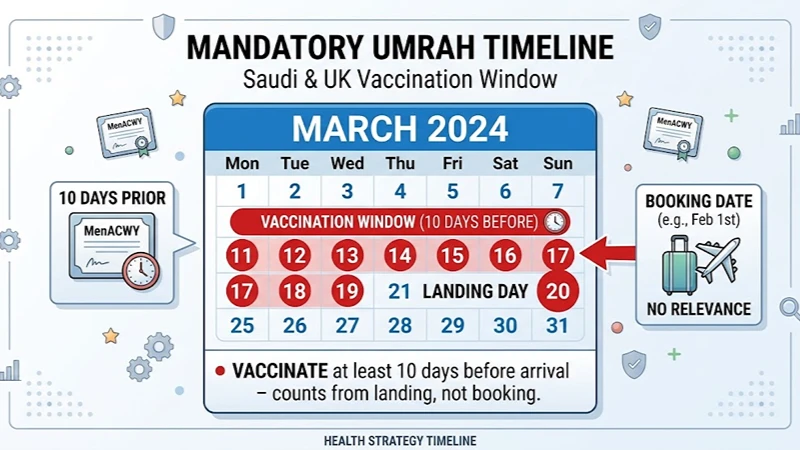
The two points of failure nobody ages on your pharmacy page — You. First, the spelling. Your certificate must clearly display your name, the vaccine you took, its type and date — all information that is compared with the passport by the Nusuk system. The most common trip-up, processors say, is the Mohammad versus Muhammad split — a passport with one spelling and a supporting document that uses the other. Just one character is enough to hold you up. Second, the issuing clinic. The clinic was not licensed by Saudi authorities and so these perfectly genuine certificates are rejected. Get it through either a registered UK travel clinic or your GP and check your name against the passport, letter by letter, before you leave the building.
NHS or private? The honest answer
There are no hard-and-fast rules here, with some UK pages contradicting others. Later MenACWY will be given at some GP surgeries to pilgrims. Some treat it as a travel vaccine (outside of the NHS remit), while others will give it but refuse to provide the vaccination certificate format which Saudi authorities demand. Doses from private clinics cost about £35 to £60, and they give you your certificate the same day.
Ring your surgery first. If they say no, or the wait is six weeks, go private and stop lamenting.
On the other hand, the Medicines: perhaps the one topic that most guides to UK practice miss
This is the change that fools people. A clearance permit for controlled drugs containing narcotic or psychotropic substances carried by travellers arriving in Saudi Arabia or departing from its borders can be obtained through the Saudi Food and Drug Authority. You register via its cds, (Controlled Drugs System). sfda. You may register on cds.sfda.gov.sa, by registering an account in the website and uploading a prescription with a medical report and proof of identity. Travelers arriving or departing with listed medications without that clearance may encounter difficulties at customs.
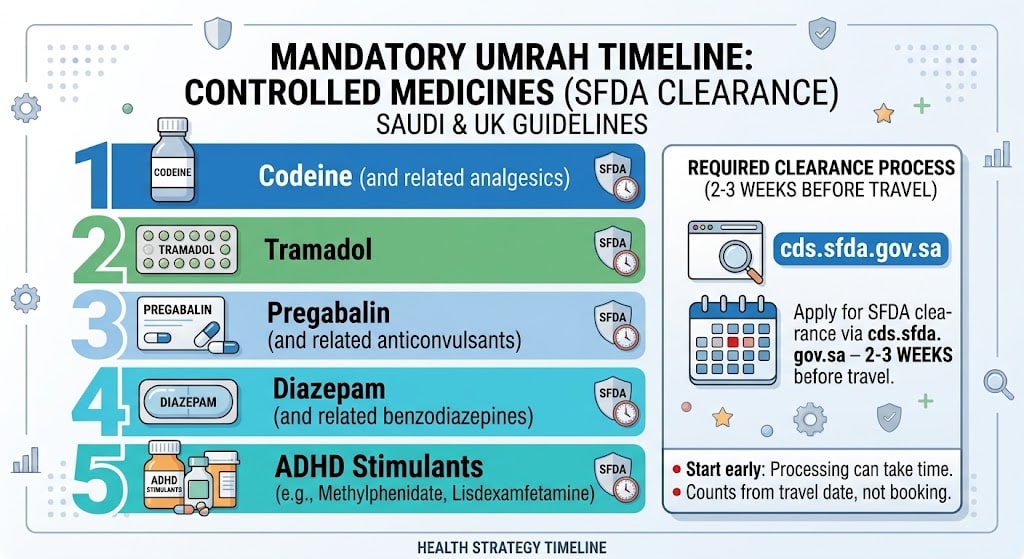
It reaches further than naim pilgrim list most people would expect. In scope there are codeine based painkillers, tramadol, pregabalin, diazepam and ADHD stimulants. And many older pilgrims carry at least one of these without ever thinking that it was a controlled substance.
Handy version: Leave everything in its original packaging; Remember to take your repeat prescription with you; divide supply between hand luggage/hold bag and pack enough just in case you get delayed coming home! GOV.UK recommends ensuring that you have enough medicine for your whole journey including if you return later than planned.
Insurance, SAR 100k cap
Health insurance up to 100,000 Saudi riyals is included in your entry permit, but GOV.UK states that medical treatment in Saudi Arabia can be costly and advises you consider buying extra travel insurance for additional coverage over this amount. Your GHIC is worthless here. Disclose any heart condition, diabetes or recent hospitalization. Undeclared condition — the single most common reason a repatriation claim can fail.
Heat, feet and the crowd
In the summer, the temperature can reach over 50 degrees Celsius and contagious diseases easily spread due to large press of people coming together during Hajj and Ramadan with flu, colds and respiratory problems relatively common. The viral lung infection, now popularly known as Hajj cough, varies from a minor nuisance to something serious enough to disrupt the performance of the rites.
Drink before you feel thirsty, utilize the Zamzam points in the Haram, and take oral rehydration sachets for use in burnt heat instead of drinking common water. Tawaf and Sa’i (demonstrations of hurrying around the Kaaba, which is day by day during Hajj) are performed either barefoot or in shoes on hot marble prompting rankles and congresses to the feet being one of the most widely recognized minor injury. Bring plasters and small tube of anti-fungal cream.
Which leads to edge cases: the over-65s and those with a chronic heart, kidney or respiratory condition should be assessed for fitness before booking, not after. Women who are thinking of taking period delay tablets need to speak with a GP weeks in advance. GOV.UK also cautions that UK based organised criminal gangs approach people arranging Hajj or Umrah travel options, the potential of victims being over 65 incurring high costs, suggesting customers to check out your operator before putting down deposits.
FAQ
What Vaccines Required for Umrah?
The quadrivalent MenACWY meningococcal vaccine is the only hard requirement. In addition, pilgrims should be fully vaccinated according to the routine UK vaccination schedule and receive boosters as appropriate (eg MMR, diphtheria, tetanus and polio). Seasonal flu is vaccine-preventable, but it is recommended instead of mandatorily.
Is the meningitis vaccine available with a fee from NHS for Umrah?
Sometimes, and that entirely depends on your surgery. MenACWY is routinely given to teenagers, but certain at risk groups qualify from any age. However, most adult pilgrims will find that their GP won’t offer it as a travel vaccine, or won’t sign-off the mandatory certificate, so will pay privately. Assume either way until your practice begs to differ.
How soon prior to Umrah should I be vaccinated?
Minimum of 10 days before the day of arrival in Saudi Arabia. Aim for four to six weeks. And your Nusuk application will typically require a scanned certificate, meaning leaving it until the last fortnight leaves you racing after your own paperwork.
What is the validity of this Umrah meningitis certificate?
Three Years Is the Guidance from Saudi in 2025. Conjugate vaccines [for overseas travel papers in the UK] can be quoted as five years by many clinics. However, given this contradiction, treat three years as your maximum working limit and re-vaccinate if your certificate is older than this (especially important for anyone doing Umrah regularly).
Am I allowed to bring my prescription medication into Saudi Arabia?
Yes ordinary prescriptions, in original packaging with a photocopy of the prescription. Medicines containing narcotic or psychotropic substances require an electronic clearance from the SFDA before board. Apply through the CDS Portal two to three weeks prior to your trip and carry your approved permit in hand baggage.
What if I show up without a certificate?
In reality you’ll never get further than that, because the certificates are checked when you apply via Nusuk. Identification of a gap at the border means possible delay, denial of entry and vaccination at your expense on arrival.
How to not get sick in Umrah?
Hand wash frequently, use mask in dense crowds and on transport, do not share drinking bottles or towels and rest up between rituals. If after this you become unwell with a fever, severe head ache, stiff neck or rash contact your GP or NHS 111 citing recent travel within two weeks of returning (or 999 in an emergency).
What to do this week
The TravelHealthPro Hajj and Umrah factsheet from NaTHNaC and the FCDO’s Saudi Arabia pilgrimage advice on GOV.UK should be opened as both are updated when requirements change in Saudi Arabia. If any of your medicines may be included, visit Controlled drugs guidance at the Saudi Food and Drug Authority. Finally, call your GP today and ask two things: do you offer the MenACWY to pilgrims, and will you give the certificate. Imprint privately the equivalent evening in the event that you replied no to either.
Mandatory requirements: It would be prudent to restrain multiple factors of data as per Saudi health directives published each Hajj and Umrah season, especially that 1447H guidance may change during the year. Please note that nothing here substitutes for a proper consultation, especially if you are pregnant, immunosuppressed or have a chronic condition.