Here’s what surprises many first-time Umrah pilgrims: The rituals themselves last only 4-6 hours and are a fraction of the time needed for Hajj, but most packages begin at seven days. Why the gap?
Having facilitated the Umrah travel for hundreds of UK families, what I’ve seen is that picking out the right length isn’t just a case of ticking boxes – it’s about striking the perfect balance between your spiritual needs and real-world factors such as work commitments, your budget and how you recharge.
Let me guide you through what I’ve learned about what works for various kinds of pilgrims.
The 101: Ritual Time Versus Total Stay
The actual rituals themselves-Ihram, Tawaf, Sa’i and Halq-really do only take 3 to 6 hours. I’ve watched pilgrims complete the walk in as little as three hours when it’s quiet, although five or six becomes the average during busier times.
But here’s what the basic numbers don’t reveal: you’re not going to Saudi Arabia simply to rush through rituals and catch a flight home.
Think about it. You’ve just been on a 6-8 hour flight from the UK, through two time zones and arrived in an environment very different to that of Manchester or Birmingham. Your body needs recovery time. Your soul has to absorb the experience.
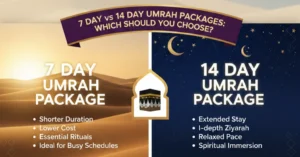
UK based travel operators usually provide packages between 7-30 days (minimum) and the Saudi Umrah Travel Formalities standard limits stay up to 90 days. The sweet spot? From what I have seen, 7-14 days delivers you the best results for most British Muslims.
Different Pilgrims, Different Lengths: A Framework for Practice
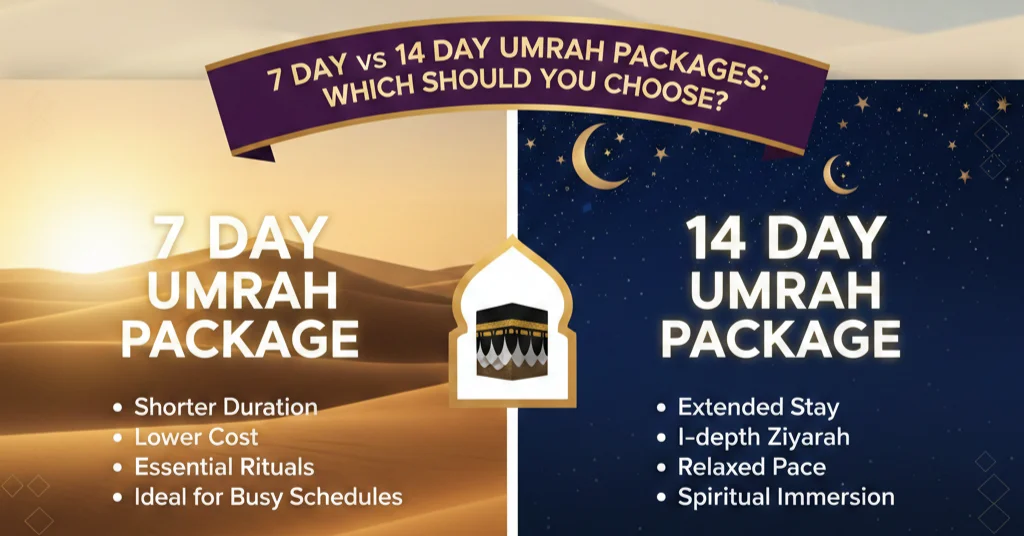
The Weekend Warrior (7 Days)
Ideal for: Time-poor professionals, minimal annual leave, budget-conscious pilgrims
This constricted time-frame usually amounts to 3-4 days spent in Mecca and 2-3 days in Madina. You will perform your Umrah, visit the Prophet’s Mosque, and come back spiritually revitalised.
The reality check? It’s intense. And you’re contending with jet lag, not to mention also getting around in a new place all the while trying to perform deeply meaningful rituals and maybe see some nearby historical attractions. One client told me she felt she had sort of just hit her stride when it was time to pack up.
On the budget end, 7 day packages from the UK generally cost upwards of £900-£1,200 per person sharing, depending on how far away hotels are other than al-Haram.
The Balanced Journey (10-14 Days)
Ideal for: First-timers, families with children, people seeking spiritual depth without haste
I wish I had better and more general advice, but this is my personal recommendation for the majority of people. Here’s why: you land on day one, sleep for the night, do an Umrah on the second or third with your head in it and then spend however many days doing marchicats – deep worship, visitation to key Islamic sites and yes- do extra umrahs as well.
The actual rituals may themselves last four to six hours, but the prayers, a few of those still moments in Rawdah itself, and the leisurely tawaf at fajr—they need space.
A 10-day package generally consists of about 5 to 6 days in Makkah and 4 to 5 days in Madinah. This gives you time to:
- Take some time to acclimate to the difference in time
- Do as many umrah (some 2-3 umrahs during their time)
- Experience the weight of history without wearing yourself down
- Enter the Haram at various different times of the day (fajr, after maghrib, late night)
- Rest between intensive days
£1,200-£1,800 per person from the UK, depending on accommodation level.
The Extended Retreat (15-30 Days)
Good for: Retirees, sabbaticalers, spiritual seekers seeking to go deep
I’ve observed something common among pilgrims who stay for 2-4 weeks: They come back wildly transformed. The extra time permits the kind of deep spiritual work that is impossible in seven days.
You’re no longer a tourist with that length of time. You establish routines — certain times for prayer belong to you, certain patches of the Haram become familiar, shopkeepers acknowledge you. Some of the pilgrims I’ve worked with have gone for Umrah five or six times in a monthlong journey, and learned something new each time about their faith.
The practical benefit? You can visit during shoulder season (October through December or January to February) when prices come down and crowds disperse. 30 day 3-star £2,000-£2,500 pp — working out at about £66-83 per day.
The Overlooked Variable: Recovery Time
Let me tell you something about a place from personal experience that most travel guidebooks do not. That first 24-48 hours afterwards post flight out from the UK is huge.
You arrive in Jeddah 6-8 hours later, perhaps with a stopover. Saudi Arabia is two hours ahead of UK time. The change in temperature can be jarring—leaving a wet Birmingham to 35°C heat in Makkah is quite the shock to your system.
And I would advise you arriving in the afternoon or evening, going to your hotel getting a proper sleep and starting your Umra next day. Don’t rush it. The rituals feel more meaningful when you are in attendance, not when you’re waging weariness and disorientation.
Factor in some recovery before the flight home, too. Walking for Tawaf and Sa’i (and moving through large numbers of people on the crowded ground) sucks the energy out of you. Schedule yourself a buffer day before your return flight.
What Actually Occurs on Extended Visits?
Here’s a more realistic fact-based breakdown of what people do with their time outside of the annual core rituals:
| Activity Category | What You’ll Do |
|---|---|
| Spiritual Activities | Multiple Umrahs (each 4-6 hours) Long salats in Rawdah: The blessed garden of Madinah (Saudi Arabia) Quranic study and reflection Night prayers and tahajjud Dua sessions during accepted times |
| Historical and Educational | Visiting Hira Cave where the revelation commenced Jebel-al-Rehma and other places in the Makkah Historical Masjids in Madinah (Quba, Qiblatain) Museums and Islamic heritage sites Knowledge circles if proficient in Arabic |
| Practical Necessities | Gift shopping (Dates, Prayer items, Zamzam) Leisure days (very important for elderly and families) All meals and social hour with other pilgrims Recovery from long prayer sessions |
Seasonal Considerations That Change Everything
The “right” amount of time also partly depends on when you travel.
| Season | Duration | What to Expect | Best For |
|---|---|---|---|
| Ramadan | 10-14 days | Crowds multiply and temperatures soar. The spiritual benefits are great but the physical strains also wear heavily. | Those ready for fasting and rituals in the heat |
| Shoulder Seasons (October to December, January-February) | 7-14 days | Comfortable weather, manageable crowds and potential savings on prices. This is when the 7-day packages really shine. | Most pilgrims – ideal conditions |
| Summer (June-August) | 7-14 days | The cheapest time for packages, but it can reach 45°C; unless you’re very heat hardy, even the simplest task will feel like a chore. | Budget travelers with high heat tolerance |
| Hajj Months (Dhul Qadah and Dhul Hijjah) | N/A | Umrah Travel Formalitiess are not granted. Plan accordingly. | Not available for Umrah |
The Budget Reality Check
Let’s talk money honestly. Umrah fees add up in the following ways:
| Cost Category | What’s Included |
|---|---|
| Tour Price | Flights, hotels, transfers, Travel Formalities |
| Food | Beyond breakfast |
| Shopping and gifts | Dates, Prayer items, Zamzam |
| Ziyarat tours | Guided historical site visits |
| Additional expenses | Laundry, tips, extras |
A 7-day economy trip from UK costs around £900-£1,200. But when you consider daily costs (budget £30-50 per person), shopping and emergencies, make it a minimum of £1,200-£1,500.
Packages cover 14 days (£1,400-£2,000), but get this: Your daily rate is actually lower. You’re spreading fixed costs (flights, Travel Formalitiess) across more days.
I have met families who saved for two years to be able to spend 10 days in 4-star hotels close to Haram. Others opted to spend 14 day-long quarantine in 3-star rooms elsewhere taking the money saved for better meals and gifts. It’s not a wrong answer, just what you prioritize.
My Honest Recommendation for First-Timers
If this is your first Umrah, shoot for 10-12 days if you can swing it.
Here’s my reasoning. Day one, you will flounder a little; everyone does. The Haram is huge, it takes time to navigate. You will forget Duas, you’ll have to consult your guide, and find that you’re moving slower than anticipated.
By day three or four, you’ve settled into a groove. You know which gate is nearest the Kaaba, when the Mataaf (the area around the Kaaba) is least crowded, where the best zamzam stations are.
Days 5–8 is when the magic all goes down. You actually are comfortable enough to be entirely present, to cry during Tawaf without thinking of logistics, to make a powerful dua without pulling out your phone for the Arabic transliteration.
That depth? It’s not an easy place to get your head around in seven days, especially while fighting the nightmare of jet lag and newness.
Expert Tips That Actually Matter
| Tip | Why It Matters |
|---|---|
| Plan More Than One Umrah | If you are staying 10 days or more, perhaps schedule various umrahs at varied times (for instance, one during your first night, another during fajr for the peacefulness and perhaps a final one before leaving). Each offers different spiritual insights. |
| Strategically Book Hotels | Near Haram costs more but extra hours of travel saved and energy is spent. I have seen families who can walk themselves into the ground for 20 minutes each way four times a day. Those savings evaporated in fatigue. |
| Take Friday into Account | If you can, try to spend a Jummah in Madinah. As you may expect, the experience of Friday prayer at the Prophets Mosque is amazing! |
| Pack Light | You’re going to gain things (dates, zamzam, gifts). Try to make sure there’s room in your luggage, and keep airline weight limits in mind. |
| Preserve Rest days | For stays of 14 or more days rest properly. Your spiritual life gets better when you are not woke! |
Common Questions from UK Pilgrims
| Question | Answer |
|---|---|
| Is it really possible to actually get it all done in 7 days? | Yes, but it’s rushed. You will be performing the rites and seeing the holy places, but you won’t have much time for extended reflection or multiple Umrahs. |
| Is 30 days too long? | Only you can answer that. Some settle in at three weeks just splendidly, others get squirmy at day 10. Try a 10-14 day long trip for your first Umrah and modify for subsequent trips. |
| What if I can only take five to six days off work? | It’s doable, though tight. Thursday night departures (arrive Friday) maximize weekend coverage. Be realistic about the extent of jet lag. |
| Shall I divide the time between Makkah and Madinah? | Because it’s the location of Umrah, most packages spend a little extra time in Makkah. A common split for 10 days: 6 in Makkah, 4 at Madinah. |
| How about travel with elderly parents or young children? | Add at least 2-3 days to typical transit times. Both groups need more sleep, operate more slowly and have less cushion for the sorts of unanticipated challenges that are guaranteed to come up. |
The Decision Framework That Works
Ask yourself these questions:
| Key Question | Why It Matters |
|---|---|
| How many of my annual leave days can I sacrifice? | Determines maximum possible duration |
| What’s my realistic total budget? | Influences package type and duration |
| Is this my first Umrah or a repeat? | First-timers need more time to adjust |
| Am I traveling alone, with my spouse or with family? | Families need longer durations |
| Do you want Umrah multiple times or a single Umrah? | Multiple Umrahs require 10+ days |
| How much does it matter to see historical sites outside of the Harams? | More sites = more time needed |
| Do you need downtime (health, age or conditioning)? | Physical limitations require buffer days |
More than any general recommendation, your responses should lead to duration.
Making It Work for You
The right amount of time isn’t the same for everyone. I have witnessed pilgrims changed on focused 7-day journeys and others who needed a full three weeks to integrate fully the experience.
The only thing that does matter is if we go into this journey having the right expectations and planning with honesty. Seven days or thirty — make every day count.
The rituals — the whole thing takes only six hours, but God does it ever have an impact: A spiritual cleansing, a rekindled relationship with Allah and simply that feeling of peace you lug home in your suitcases that stays with you for life.
Time your stay with what will enable you to come back and not just completed Umrah, but really did it.
Related Resources:
- Browse our complete range of Umrah packages tailored for UK Muslims
- Explore 21-day Hajj packages for extended spiritual journeys