
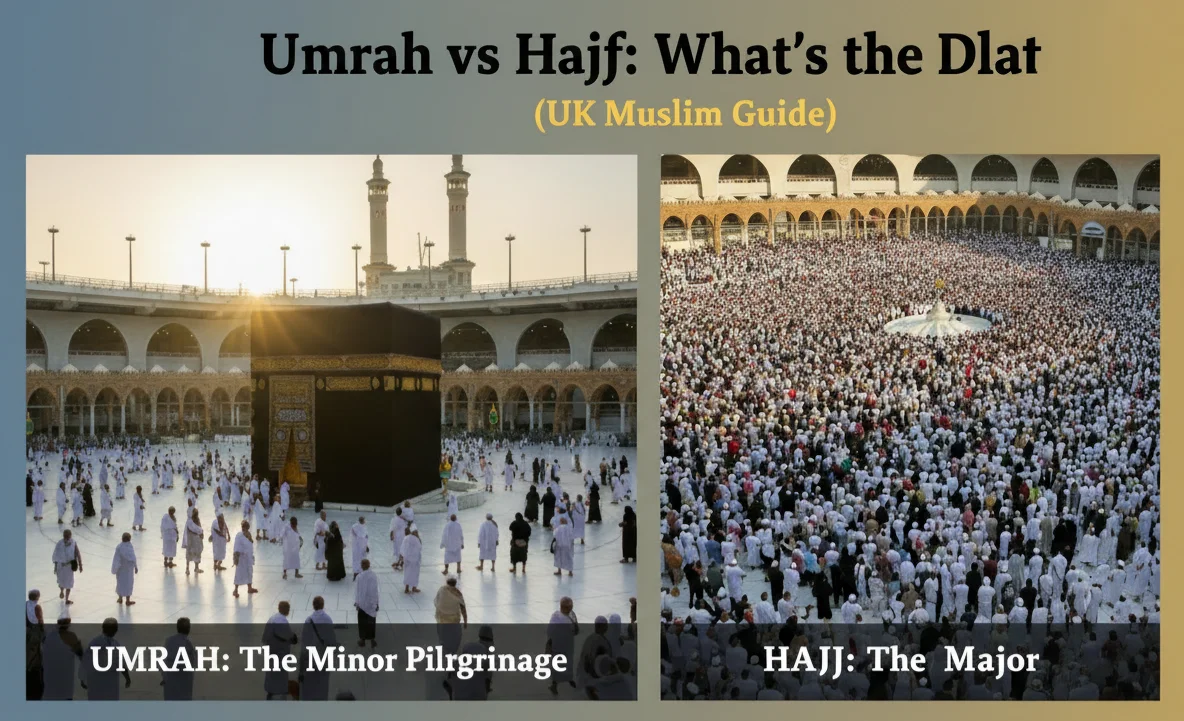
If you’re sitting here wondering whether to book Umrah or start saving for Hajj, you’re asking the right question. After helping thousands of UK Muslims plan these journeys over the past decade through our Manchester travel agency, I’ve seen this confusion countless times. Let me break it down in a way that actually makes sense.
Here’s the straight answer: Hajj is Islam’s fifth pillar and mandatory once in your lifetime if you’re able. Umrah is optional but highly rewarding, can be done any time of year, and takes just a few hours compared to Hajj’s five to six days.
But that’s just scratching the surface. The decision between these two sacred journeys involves timing, costs, physical demands, and your personal spiritual goals.
The Real Difference Nobody Talks About
Most articles list the ritual differences, but here’s what I’ve learned matters most to UK pilgrims: Hajj fundamentally changes you in ways Umrah doesn’t, simply because of the intensity.
I’ve watched families return from both. Umrah pilgrims come back refreshed and spiritually energised. Hajj pilgrims? They’re transformed. The exhaustion, the crowds of 2-3 million people, sleeping under stars in Muzdalifah – it strips away everything superficial.
That’s not to diminish Umrah’s value. Think of Umrah as your spiritual tune-up. You can do it multiple times, perfect your rituals, and build that muscle memory. Many British Muslims I work with do Umrah first specifically to prepare for Hajj later.
Breaking Down the Rituals: What You’ll Actually Do
Umrah’s Four Core Steps
You enter Ihram (that state of purity and intention), perform Tawaf by circling the Kaaba seven times, complete Sa’i between Safa and Marwa, then shave or trim your hair. Done. Most people finish in four to six hours.
Hajj Includes All of That, Plus
Standing at Arafat on the 9th of Dhul Hijjah (this alone is considered the pinnacle of Hajj), spending the night in Muzdalifah collecting pebbles, stoning the pillars at Mina representing rejection of Shaytaan, and offering Qurbani (animal sacrifice). Each ritual carries profound meaning linked back to Prophet Ibrahim’s trials.
The Money Talk: UK Costs You Need to Know
Let’s be blunt about finances because this matters for planning.
Umrah Packages from UK (2026)
| Package Type | Price Range |
|---|---|
| Budget 3-star | £1,200-£1,600 |
| Mid-range 4-star | £1,600-£2,100 |
| Premium 5-star | £2,100-£2,500 |
Hajj Packages from UK (2026)
| Package Type | Price Range |
|---|---|
| Economy | £5,700-£6,500 |
| Standard | £7,000-£9,500 |
| Premium | £9,500-£12,000+ |
The price jump reflects duration (you’re away 18-21 days for Hajj versus 7-10 for Umrah), the additional accommodation requirements during Hajj days in Mina and Arafat, and frankly, the increased demand.
Pro tip from years of bookings: Start a dedicated savings account as early as possible. Many British Muslims I know save £200-£300 monthly for 2-3 years to afford Hajj without financial strain.
Can You Do Umrah Instead of Hajj?
Short answer: No.
I get asked this weekly. The Hadith about Umrah in Ramadan equalling Hajj in reward causes confusion. Here’s the clarification: the reward might be comparable, but it doesn’t fulfil the obligatory pillar of Hajj.
If you’re financially and physically capable of Hajj, you must perform it at least once. Umrah – even 20 Umrahs during Ramadan – won’t tick that box. The obligation remains.
Think of it like this: you can’t substitute voluntary charity for Zakat, or voluntary fasts for Ramadan. Same principle applies here.
Which Should You Do First?
Based on working with thousands of UK pilgrims, here’s my honest framework:
Do Umrah First If
| Scenario | Reason |
|---|---|
| You’ve never been to Makkah | Familiarise yourself with the environment |
| Can’t get 2-3 weeks off work yet | Umrah requires less time commitment |
| Building up savings for Hajj | Perform pilgrimage now while saving |
| Want to test your physical stamina | Hajj is significantly more demanding |
Prioritise Hajj If
| Scenario | Reason |
|---|---|
| You’re over 55 | Physical ability may decline with time |
| Have the full amount saved | Time and finances are aligned |
| Health concerns exist | Conditions might worsen with delay |
Real scenario I see often: A 35-year-old client does Umrah, learns the ropes, gets comfortable navigating Makkah, then tackles Hajj three years later with confidence. It’s a solid strategy.
The Physical Reality
Hajj will test you. I tell every client this upfront.
You’re walking 5-10 kilometres daily in Saudi heat. You’ll share tents in Mina with strangers. Muzdalifah means sleeping on ground mats under open sky. The crowds during Tawaf can be overwhelming – imagine trying to circumambulate the Kaaba with thousands pressing in from every side.
Umrah is comparatively manageable. You control the pace. Visit during quieter months like January or February from the UK, and you can complete Tawaf without being shoulder-to-shoulder with others.
Physical fitness genuinely matters for Hajj. Start walking 30-45 minutes daily at least three months before departure. Your knees will thank you.
The Timing Factor
Umrah’s flexibility is its greatest advantage for UK Muslims. School holidays? Go during Easter or summer break. Want to avoid crowds? Book January or February when Manchester flights are cheaper too.
Hajj happens during five specific days in Dhul Hijjah (approximately late May 2026). You can’t reschedule. You can’t postpone. Miss those dates, and you’re waiting another year.
UK employers have legal protections for religious observance, but requesting three weeks off requires proper planning and communication months in advance.
Five Questions I’m Always Asked
Can I combine both in one trip?
Absolutely. Many packages include Umrah before or after Hajj. You’ll pay more, but it’s spiritually rewarding and logistically efficient.
How crowded is Hajj versus Umrah?
Hajj sees 2-3 million pilgrims; Umrah varies but is always lighter. During Ramadan, Umrah gets busy but nothing like Hajj’s intensity.
Do I need a Travel Formalities for both?
Yes, but the process differs. Umrah Travel Formalitiess UK citizens can arrange through ATOL-licensed agents like ours for £80-£130. Hajj Travel Formalitiess require specific permits and earlier application.
Can women do Hajj alone?
Women under 45 need a mahram (male guardian). Over 45, they can travel in groups. Rules update periodically, so verify current Saudi regulations when booking.
What if I’m physically unable to complete all rituals?
Islamic jurisprudence provides accommodations. You can designate someone to perform rituals on your behalf in certain circumstances. Consult a qualified scholar for your specific situation.
My Honest Recommendation
Start with Umrah if you haven’t been. Experience the spiritual magnitude of standing before the Kaaba without the time pressure and physical demands of Hajj. Use it as preparation.
But don’t delay Hajj indefinitely if you’re capable. I’ve seen too many people postpone for “perfect timing” until health or circumstances make it impossible. The obligation is there for a reason.
Your spiritual journey is personal. Whether you choose Umrah’s focused intensity or commit to Hajj’s transformative experience, both paths lead to the same sacred ground. What matters is your intention and sincerity.
Ready to take the next step? Look for ATOL-protected Umrah packages from reputable UK operators, compare what’s included (flights, accommodation distance from Haram, Travel Formalities processing), and don’t hesitate to ask questions. This journey deserves thorough planning and genuine understanding.
Related Articles: